
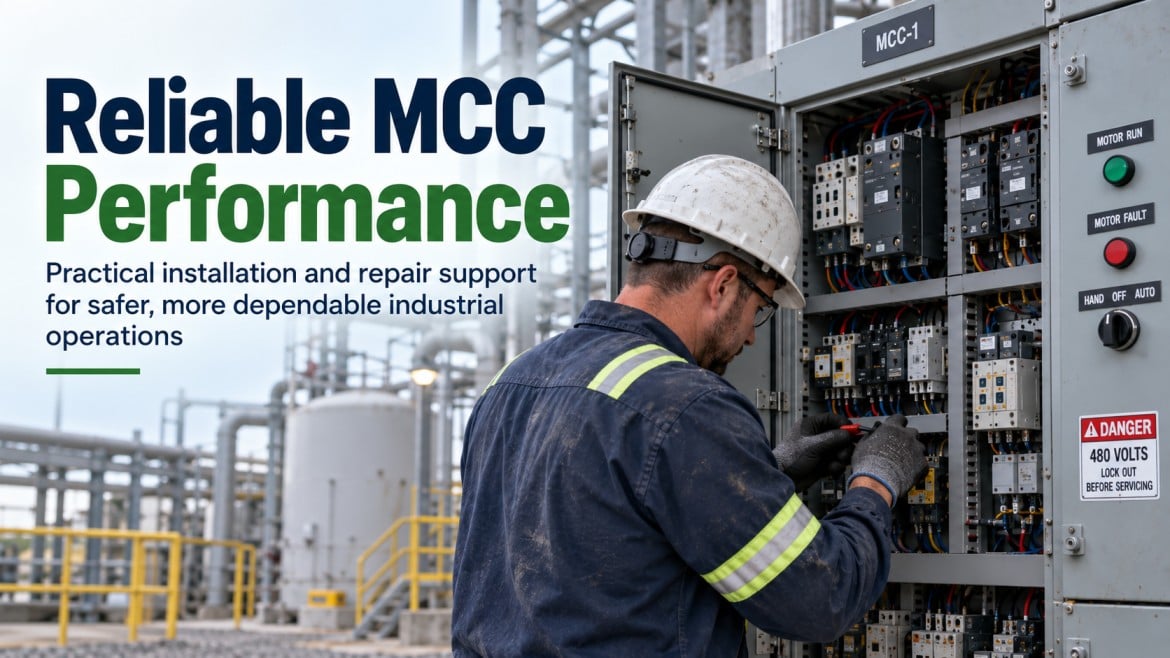
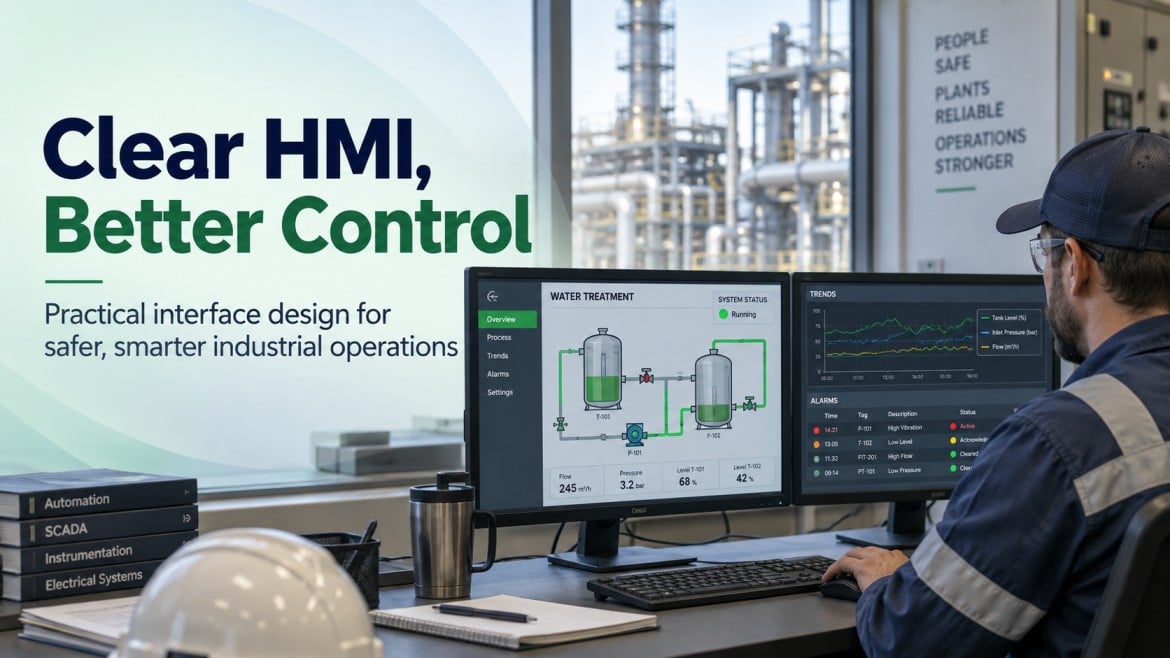


SCADA facility automation in Lafayette, L, connects field sensors, PLCs, and control software so operators can monitor and run equipment like pumps, chillers, and compressors from one screen. It cuts downtime, supports OSHA and PHMSA compliance, and replaces manual rounds and paper logs with real-time data.
Your operator is still walking the yard with a clipboard, and a pump failure at 2 a.m. costs you a phone call, a drive, and a shift of lost production. That is the exact problem SCADA facility automation in Lafayette, LA, is built to solve. A well-designed system watches your equipment around the clock and flags trouble before it becomes a shutdown.
I have spent 15 years pulling wire, programming PLCs, and troubleshooting SCADA panels across Louisiana’s oil and gas, municipal, and industrial sites. I have seen aging RTUs held together with electrical tape, and I have seen brand new installs fail in month one because nobody planned for Gulf Coast humidity and hurricane season. The fix is not always a full rip and replace. Often, it is a smarter retrofit.
In this guide, you will learn what SCADA actually does, how it differs from a PLC, HMI, DCS, or BMS, and which deployment model fits a Gulf Coast facility. You will also see the equipment SCADA typically automates, the cybersecurity steps that protect you from a pipeline-style attack, and the compliance rules that apply here in Louisiana. By the end, you will know exactly what to ask before anyone touches your control system.
Key Takeaways
- SCADA facility automation ties field devices, PLCs, and dashboards into one system, so your team catches problems before a pump trips or a tank overflows.
- Retrofitting a legacy SCADA system usually costs less than a full replacement, but only when the existing PLCs and wiring are still sound.
- Louisiana facilities that handle hazardous processes fall under OSHA 1910.119 and PHMSA rules, and your alarm and shutdown logic has to prove it.
- SCADA cybersecurity is not optional. Network segmentation and IEC 62443 practices protect against the same threats that have hit Gulf Coast pipelines and utilities.
- Lafayette’s oil and gas, water treatment, and food and beverage plants each need a different SCADA setup. What works for a compressor station will not fit a wastewater plant.
What Is SCADA (Supervisory Control and Data Acquisition)?
SCADA is a system of hardware and software that lets you monitor and control industrial equipment from a central location. Instead of sending someone to check a tank level or a compressor pressure by hand, SCADA pulls that data automatically and displays it in your control room or on your phone.
How SCADA Works
SCADA works in three layers. Field devices, such as sensors and valves, collect the raw data. A PLC (programmable logic controller) or RTU (remote terminal unit) processes that data locally and follows the logic your technician programs into it. The SCADA server then gathers information from every PLC and RTU on the network and shows it on an HMI (human machine interface) for your operators.
Here is a real example from a Lafayette gas processing site. A pressure transmitter on a separator vessel sends a signal to the PLC every second. The PLC checks the reading against a setpoint. If pressure climbs too high, the PLC opens a relief valve automatically and sends an alarm to the SCADA screen, often before an operator would ever notice a gauge move.
Why SCADA Is Essential for Facility Automation
SCADA is the backbone that makes facility automation possible. Without it, you have isolated PLCs that never talk to each other and no central record of what happened. With it, you get one dashboard, one alarm history, and one set of trend data you can hand to an auditor or a PHMSA inspector.
- Cuts the need for manual rounds and paper logs
- Builds an alarm history you can pull up in seconds, not hours
- Let’s have one operator supervise equipment across several buildings or well sites
What Is Facility Automation?
Facility automation means using control systems to run building and process equipment automatically, based on schedules, setpoints, or real-time conditions. It covers everything from a thermostat that adjusts itself to a compressor station that shuts down on its own when it detects a gas leak.
Facility Automation vs. Building Automation
People use these terms interchangeably, but they are not the same. Building automation, often run through a BMS (building management system), typically handles comfort systems: HVAC, lighting, and access control in offices, schools, and retail spaces. Facility automation is the broader term, and in an industrial setting, it includes process equipment like pumps, boilers, and compressors, not just comfort systems.
A food and beverage plant in Lafayette might run a BMS for the office side and a full SCADA system for the production floor. Both fall under facility automation, but they use different hardware, different protocols, and often different vendors.
The Role of SCADA in Industrial Facilities
In an industrial facility, SCADA is the layer that ties process automation and facility automation together. It monitors production equipment, tracks energy use, and, in many Louisiana plants, feeds data directly into the environmental reporting required by LDEQ (Louisiana Department of Environmental Quality).
SCADA Architecture & Core Components
The Automation Pyramid (Field Devices → PLCs/RTUs → HMIs → SCADA Servers → Enterprise Systems)
Picture SCADA architecture as a pyramid with five levels, each one depending on the one below it.
- Field devices: sensors, transmitters, actuators, and valves that touch the physical process
- PLCs and RTUs: local controllers that run the logic and talk directly to field devices
- HMIs: the screens operators use to view and control equipment in real time
- SCADA servers: the central system that gathers data from every PLC and RTU on the network
- Enterprise systems: ERP, MES, and reporting platforms that use SCADA data for business decisions
A weak link at any level, such as an undersized RTU or a field sensor that has drifted out of calibration, throws off every layer above it. That is why we calibrate instruments on a set schedule instead of waiting for a complaint.
SCADA Software, Historians & Operator Workstations
The SCADA software is the platform your operators interact with daily. Common platforms we install and support on Louisiana sites include Ignition by Inductive Automation, AVEVA System Platform (formerly Wonderware), Rockwell Automation FactoryTalk View, and Siemens WinCC. Each one talks to PLCs a little differently, but they all do the same core job: display data, log alarms, and let operators issue commands.
A historian is a specialized database that stores every tag value over time, often at one-second intervals. This is what lets you pull a pressure trend from six months back when you are trying to figure out why a compressor seal failed. AVEVA PI System and Ignition’s built-in historian are the two we see most often on Gulf Coast installs.
Operator workstations need to be rated for the environment in which they sit. A control room inside a manufacturing plant is a different job than an unmanned RTU cabinet near a wellhead in humid, salt-air conditions. NEMA 4X enclosures are standard on most outdoor Louisiana installs, and that is not a detail to skip to save money up front.
Communication Networks & Protocol Overview
SCADA components talk to each other through industrial protocols. Modbus is the oldest and most common, especially on legacy equipment. DNP3 shows up often in water and utility SCADA because it handles time-stamped data well. OPC UA and Ethernet/IP are newer standards built for faster, more secure communication between modern PLCs and SCADA servers. We walk through protocol selection and network design in detail as part of our mechanical and controls services, since the right choice depends heavily on the equipment you already have running.
SCADA Deployment Models
On-Premise, Cloud-Based & Hybrid SCADA
On-premise SCADA runs entirely on servers you own and maintain at your facility. It gives you full control and does not depend on an internet connection to keep running, which matters during a hurricane when your connectivity might drop before your power does.
Cloud-based SCADA stores data and, in some setups, runs the historian on a remote server managed by a vendor like AVEVA or Ignition Cloud Edition. This works well for operators managing several sites who want one dashboard for all of them. The tradeoff is that your control system now depends on internet access and a third-party vendor’s uptime.
Hybrid SCADA keeps safety-critical control logic local, on-site PLCs and RTUs that keep running with no internet at all, while pushing historian data and reporting to the cloud for remote access. This is the model we recommend for most oil and gas and water treatment clients in the Lafayette area.
Choosing the Right Deployment Model
| Factor | On-Premise | Cloud-Based | Hybrid |
|---|---|---|---|
| Works with no internet | Yes | No | Yes, for control logic |
| Multi-site visibility | Limited | Strong | Strong |
| Upfront hardware cost | Higher | Lower | Moderate |
| Best fit | Single remote site, wellheads | Multi-site corporate reporting | Most industrial and utility plants |
Your process risk should drive this decision, not the sales pitch. A single wellhead in a remote parish rarely needs cloud connectivity. A five-site manufacturing group almost always benefits from it.
SCADA vs. PLC vs. HMI vs. DCS vs. BMS
Key Differences at a Glance
| System | What It Does | Typical Use |
|---|---|---|
| PLC | Runs the logic for one machine or process step | A single pump skid or conveyor |
| HMI | A screen that an operator uses to view and control a PLC | Local control panel on a machine |
| SCADA | Supervises and logs data from many PLCs and RTUs across a site or region | Oilfield well sites, water utilities, plant-wide monitoring |
| DCS | Tightly integrated control of continuous processes in one plant | Refineries, chemical plants, power generation |
| BMS | Manages HVAC, lighting, and access control | Offices, schools, commercial buildings |
Which Automation System Is Right for Your Facility?
Ask yourself one question first: Is your process continuous and contained in one building, or spread across multiple sites with equipment that runs somewhat independently? Continuous, single-site, tightly coupled processes usually favor a DCS. Spread-out or standalone equipment, like a network of wellheads or a water utility with several pump stations, usually favors SCADA. Comfort systems always belong on a BMS, never bolted onto your process SCADA.
Some Lafayette plants run more than one of these systems at once, and that is normal. A chemical plant might have a DCS on the reactor process, SCADA supervising utilities and tank farms, and a separate BMS for the office building. The key is making sure they share data cleanly instead of becoming three disconnected islands.
Common Applications & Equipment Automated with SCADA
Industries (Manufacturing, Oil & Gas, Water/Wastewater, Utilities, Commercial)
- Manufacturing: production line monitoring, energy tracking, downtime alarms
- Oil and gas: wellhead monitoring, tank battery levels, compressor stations, pipeline SCADA
- Water and wastewater: lift station monitoring, chlorine dosing, treatment plant control
- Utilities: substation monitoring, distribution automation, demand response
- Commercial facilities: energy management, HVAC scheduling, integrated security
Equipment (HVAC, Pumps/Compressors, Boilers/Chillers, Lighting, Security)
On the ground, SCADA and facility automation typically touch these systems: HVAC units and rooftop package units, pumps and compressors across process and utility water systems, boilers and chillers in plants that need process heating or cooling, lighting controls tied to occupancy and schedules, and security systems including access control and camera integration.
For example, we recently tied a set of chillers at an industrial facility outside Lafayette into the plant’s existing SCADA historian. The plant manager could finally see run hours and energy draw next to production data, instead of getting a separate report from the chiller vendor every quarter.
Data Monitoring, Analytics & Reporting
Data Acquisition & Alarm Management
SCADA pulls data from field sensors on a set scan rate, often every second, for critical values like pressure and temperature. That data feeds directly into alarm logic. If a value crosses a setpoint, the system raises an alarm on the HMI and, in most configurations we build, sends a text or email to the on-call operator.
Alarm management deserves more attention than most facilities give it. According to the International Society of Automation (ISA), a well-tuned alarm system should generate no more than about one alarm per operator every 10 minutes during normal operation. When plants stack every possible warning as a high-priority alarm, operators start ignoring the noise, and that is exactly when a real alarm gets missed.
Dashboards, Trend Analysis & Automated Reporting
Modern SCADA dashboards let you view live and historical trends side by side. You can overlay last month’s compressor temperature against this month’s and spot a slow drift before it turns into a bearing failure. Most platforms, including Ignition and AVEVA, support scheduled PDF or email reports that go out automatically to plant managers and corporate teams.
For Louisiana facilities, automated reporting also builds the paper trail regulators expect. If PHMSA or LDEQ asks for pressure logs from a specific date, you want to pull that report in minutes, not spend a day digging through a filing cabinet.
Benefits of SCADA and Facility Automation
Reliability, Uptime & Safety
The clearest benefit of SCADA facility automation is fewer surprises. Continuous monitoring catches slow drifts, like a bearing running a few degrees hotter each week, long before they become an unplanned outage. Automated shutdown logic also protects your people. A pressure relief sequence programmed into the PLC does not hesitate or get distracted the way a person on a double shift might.
Efficiency, Compliance & Cost Reduction
SCADA also pays for itself through efficiency. Energy tracking dashboards routinely reveal equipment running longer than it needs to, whether that is a chiller cycling during unoccupied hours or a compressor running at full load with no demand. On the compliance side, automated logging removes the guesswork from proving you met OSHA 1910.119 process safety management requirements or LDEQ reporting deadlines.
One plant we support in the Lafayette area cut unplanned compressor downtime by catching vibration trends early, avoiding what would have been a multi-day outage during peak production. That is the kind of return most facilities see within the first year of a proper SCADA install.
Modernizing Legacy SCADA Systems
Challenges of Legacy Systems
We still find Allen-Bradley SLC 500 and even older PLC-5 processors running critical processes on Louisiana sites. These systems worked for decades, but replacement parts are getting harder to source, and Rockwell Automation has moved most support to its newer ControlLogix and CompactLogix platforms. When a legacy processor fails on a Friday night, waiting on a used part from an online auction is not a real plan.
Old SCADA software brings its own risk. Windows XP and Windows 7-based HMI stations are still out there running unpatched operating systems, connected to networks they were never designed to defend.
Retrofit vs. Complete System Replacement
A retrofit keeps your field instrumentation, conduit, and wiring in place while swapping the PLC, HMI software, and network gear for supported, modern equipment. This is almost always faster and cheaper than starting over, and it minimizes the downtime needed for the changeover.
A complete replacement makes sense when the existing panels are physically damaged, undersized for a planned expansion, or when the wiring itself does not meet current code. We evaluate this on a case-by-case basis. Before we recommend either path, we document the existing I/O, confirm what is actually still working, and give you a real cost comparison instead of defaulting to the bigger invoice.
SCADA Cybersecurity Best Practices
Network Segmentation & Access Control
SCADA cybersecurity starts with keeping your operational technology (OT) network physically and logically separate from your regular business network. A firewall configured with a proper demilitarized zone, following the Purdue Model for industrial network design, stops a compromised office laptop from ever reaching a PLC. Access control matters just as much. Every operator and vendor should have their own login, not a shared password taped to the panel.
The Cybersecurity and Infrastructure Security Agency (CISA) has published repeated advisories about attackers scanning the internet specifically for exposed industrial control systems, including systems in the oil and gas sector. Segmentation is not a theoretical best practice. It is the single change that stops most of these attacks cold.
Secure Remote Access & Backup/Disaster Recovery
Remote access to SCADA should always go through an encrypted VPN with multi-factor authentication, never a port forwarded directly to a PLC or HMI. We have found more than one legacy system with a remote desktop wide open to the internet during a security assessment, and that is an open invitation for ransomware.
Backup and disaster recovery plans need to cover the full system: PLC program files, HMI project files, historian databases, and network switch configurations. During hurricane season, we also recommend an offline backup stored away from the facility, since a storm that takes out your server room can take out your on-site backup right along with it.
Industry Standards & Regulatory Compliance
ISA-95, NIST & IEC 62443
ISA-95 is the international standard that defines how enterprise systems, like ERP and MES, should exchange data with control systems like SCADA. Following it makes future integration projects far less painful, because your tag naming and data structure follow a predictable pattern instead of whatever a contractor decided years ago.
NIST (National Institute of Standards and Technology) publishes the Cybersecurity Framework that most industrial security assessments reference, including guidance specific to industrial control systems in NIST SP 800-82. IEC 62443 goes further, laying out specific security levels and requirements for industrial automation and control systems. Facilities pursuing formal cybersecurity certification or insurance requirements around cyber coverage increasingly need to show alignment with one or both of these frameworks.
Louisiana Industrial Compliance Considerations
In Louisiana, electrical work on your SCADA panels and wiring needs to be performed under a properly licensed electrical contractor recognized by the Louisiana State Licensing Board for Contractors. Facilities that store or handle hazardous chemicals above threshold quantities fall under OSHA’s Process Safety Management standard (1910.119), which requires documented safety systems, and your SCADA alarm and interlock logic is part of that documentation. Pipeline operators additionally answer to PHMSA (Pipeline and Hazardous Materials Safety Administration) for control room management and SCADA-related requirements under 49 CFR Parts 192 and 195. Water and wastewater utilities report separately to LDEQ under Louisiana’s environmental regulations.
Future Trends in SCADA and Facility Automation
AI/ML, IIoT & Edge Computing in Control Systems
Predictive maintenance, powered by machine learning models trained on historian data, is starting to show up in real Louisiana installations, not just vendor demos. These models compare current vibration or temperature patterns against historical failure data and flag equipment likely to fail in the coming weeks, giving maintenance teams time to plan a repair instead of reacting to a breakdown.
IIoT sensors, wireless and battery-powered, have dropped enough in price that plants can now monitor equipment that never justified a hardwired sensor before, like individual pump bearings or remote valve positions. Edge computing pushes some of that analysis down to the PLC or a local gateway instead of sending everything to a central server first, which matters when a fast response beats a perfectly complete data set. We watch these trends closely, but we also tell clients not to chase every new sensor. Add the ones that solve a problem you actually have.
SCADA Solutions for Lafayette, LA Industries
Oil & Gas, Manufacturing & Chemical Processing
Oil and gas sites across Acadiana often run wellheads and tank batteries in classified hazardous locations, which means SCADA panels and instrumentation need to meet NEC Article 500 requirements for hazardous area electrical equipment. Remote well sites also depend on cellular or radio telemetry back to a central SCADA server, since running fiber to every location is not practical.
Manufacturing and chemical processing plants around Lafayette typically need tighter, faster control loops, closer to a DCS-style setup, combined with SCADA-level reporting for energy and compliance data. We size the network and server hardware around your specific process, not a one-size-fits-all package.
Water/Wastewater, Commercial & Food & Beverage
Water and wastewater utilities need SCADA that can survive long stretches with no on-site staff, monitoring lift stations, chlorine residuals, and pump run status across a wide service area. Commercial facilities lean more on BMS integration for energy cost control. Food and beverage plants add sanitation-driven requirements, including washdown-rated enclosures and equipment that can handle regular cleaning cycles without failing.
Choosing a SCADA & Facility Automation Partner in Lafayette, LA
Engineering Expertise & Project Implementation
A good SCADA partner brings PLC programming, instrumentation, and licensed electrical work under one roof, instead of handing you off between three different vendors who each blame the other when something does not work. Ask to see examples of similar projects, ideally in your industry and in Louisiana, where hurricane resilience and hazardous location code compliance are not optional extras.
Ongoing Support & Emergency Services
SCADA does not stop needing attention once it is installed. Ask any potential partner exactly what their after-hours emergency response looks like, not just what it says in the brochure. Advanced Energy Services has spent 15+ years supporting SCADA, I&E, and mechanical systems across Louisiana’s oil and gas, municipal, and industrial markets, and we build every system with documentation your own team can read and maintain, not a black box only we understand.
FAQ
What does SCADA stand for?
SCADA stands for Supervisory Control and Data Acquisition. It is a system that lets operators monitor and control industrial equipment, like pumps, valves, and compressors, from a central screen instead of checking each device by hand.
How much does a SCADA system cost for a small facility?
Costs vary widely based on the number of I/O points, whether you retrofit or replace, and site conditions. A focused retrofit on an existing single-site facility often runs lower than a full system replacement. We provide a site-specific quote after reviewing your existing panels and process.
Is SCADA the same as a PLC?
No. A PLC controls one machine or process step. SCADA supervises many PLCs across a site or region, collecting their data into one system and giving operators a central view and alarm history.
Do I need SCADA if I already have PLCs?
If you have more than one PLC and no central way to view alarms or trends across them, SCADA closes that gap. Many facilities run isolated PLCs for years before realizing how much time SCADA would save on troubleshooting and reporting.
What cybersecurity risks apply to SCADA systems?
The biggest risks are an unsegmented network connecting SCADA to business IT, remote access left open to the internet, and outdated software that no longer receives security patches. CISA has published advisories on attackers actively scanning for exposed industrial control systems.
How long does a SCADA retrofit take?
A single-site retrofit typically takes a few weeks to a few months, depending on the number of PLCs involved and whether production has to keep running during the changeover. We phase the work to minimize downtime whenever possible.
Conclusion
SCADA facility automation in Lafayette, LA, gives your team one clear view of equipment that used to require manual rounds, paper logs, and guesswork. Whether you run a wellhead network, a water treatment plant, or a manufacturing floor, the same core pieces apply: field devices feeding PLCs, PLCs feeding a SCADA server, and a historian keeping a record you can actually use for compliance and troubleshooting.
The decisions that matter most are the ones covered in this guide: choosing between retrofit and replacement, picking a deployment model that fits your site’s connectivity, and building cybersecurity in from the start instead of bolting it on after an incident. Standards like OSHA 1910.119, PHMSA regulations, and IEC 62443 are not paperwork for its own sake. They reflect what actually goes wrong on real sites.
We at Advanced Energy Services have spent 15+ years installing, retrofitting, and supporting SCADA and facility automation systems across Louisiana’s oil and gas, municipal, and industrial markets. If you are ready to talk through what your facility actually needs, reach out to our team for a site assessment. We will give you a straight answer about whether you need a retrofit, a full replacement, or just a few targeted fixes.