
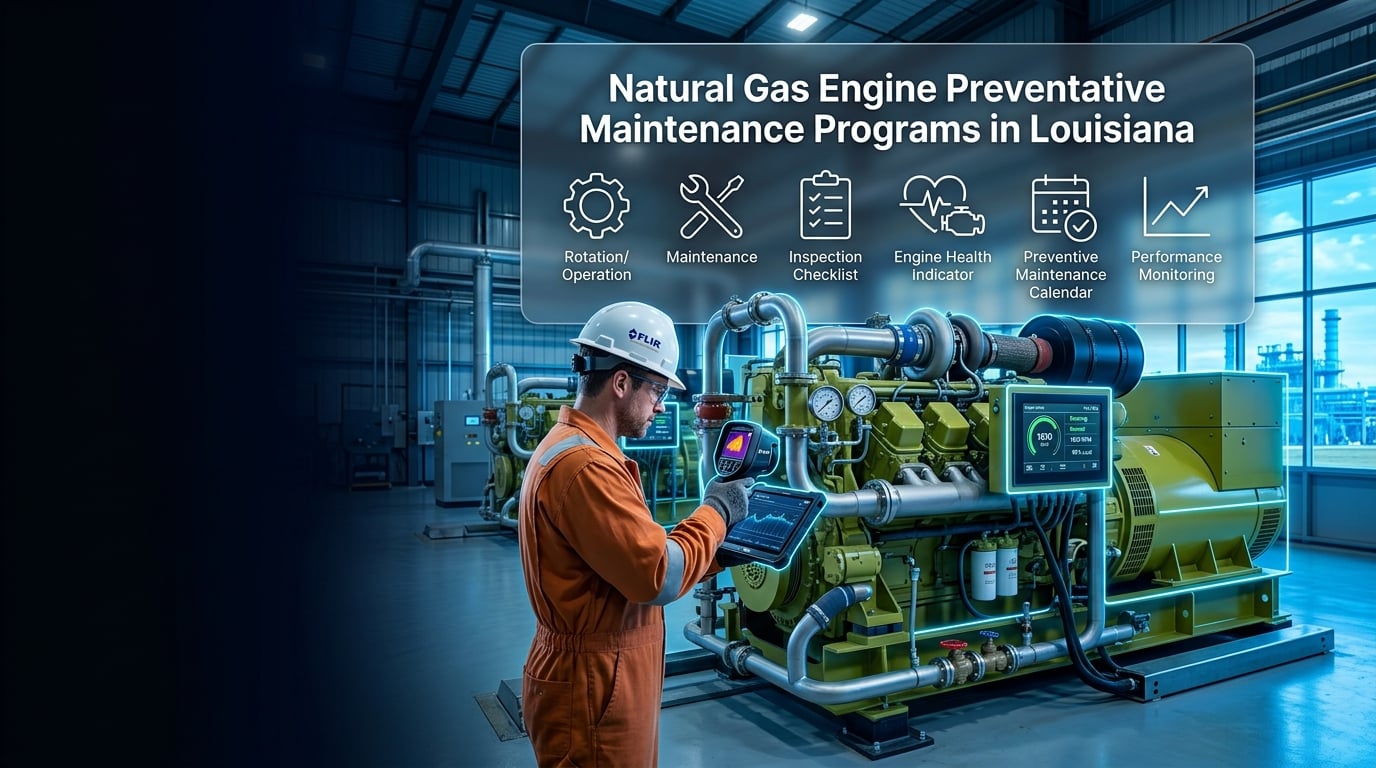
Natural gas engine preventative maintenance programs are a scheduled plan of inspections, fluid analysis, ignition and fuel system service, and periodic overhauls that keep compression, generation, and processing engines running reliably. In Louisiana, these programs also need to account for LDEQ emissions monitoring, Gulf Coast operating conditions, and each engine’s specific duty cycle.
Key Takeaways
- A complete program combines scheduled inspections, ignition and fuel system service, lubrication and cooling maintenance, and periodic overhauls, not just oil changes.
- Louisiana operators running qualifying nonemergency stationary engines may have opacity monitoring, performance testing, and recordkeeping obligations under LDEQ’s regulatory permit for stationary internal combustion engines and, where applicable, federal NSPS and RICE NESHAP requirements.
- Maintenance intervals should follow the engine manufacturer’s documentation rather than a generic schedule, since duty cycle, fuel quality, and engine design change wear rates significantly.
- Oil and coolant analysis can flag bearing wear, contamination, or combustion problems before they cause an unplanned shutdown.
- Heat, humidity, and coastal air quality in Louisiana can accelerate corrosion and filter loading, which affects how often certain tasks should be performed.
An unplanned shutdown on a natural gas engine, whether it drives a compressor, a generator, or process equipment, tends to happen at the worst possible time and carries real cost in lost throughput and expedited repair work. For engines operating in Louisiana, there is also a compliance dimension: many stationary natural gas engines fall under LDEQ air permit conditions or federal emissions standards that tie directly back to how well the engine’s combustion systems are maintained.
This guide covers what belongs in a natural gas engine preventative maintenance program, how often the work should happen, what Louisiana’s emissions requirements involve, what a program typically costs, and what to look for when evaluating a maintenance provider.
What a Natural Gas Engine Preventative Maintenance Program Includes
Program Components and Scope
A natural gas engine preventative maintenance program is a documented plan that schedules inspection, service, and testing tasks around calendar time or run hours, rather than waiting for a failure to trigger repair work. For engines used in gas compression, power generation, or process applications, the scope typically spans several systems: ignition, fuel delivery and air-to-fuel ratio control, lubrication, cooling, and the mechanical top end, including cylinder heads, valves, and related wear components.
A program also defines who performs each task, what test equipment is needed, and how results get documented. Emissions-related monitoring, when an engine is subject to LDEQ or federal air permit conditions, is typically folded into the same schedule so testing and inspection windows do not get missed.
Planned Maintenance vs. Reactive Repairs
Reactive repair addresses a failure after it happens, often under time pressure and at a higher cost. Preventive maintenance identifies wear or early degradation while the engine is still running, so repairs can be scheduled around production needs. Predictive methods, such as fluid analysis and vibration monitoring, add a further layer by using data to time interventions more precisely rather than servicing components on a fixed calendar regardless of actual condition. Most effective programs blend calendar-based preventative tasks with condition monitoring for major components.
Why Preventative Maintenance Matters for Natural Gas Engines
Reducing Unplanned Downtime and Premature Failure
Natural gas engines used in compression, processing, or standby generation applications typically run for extended periods between shutdowns, which means small deviations in ignition timing, fuel mixture, or lubrication can compound over weeks or months. A missed spark plug interval, degraded coolant, or an air-to-fuel ratio drifting outside the manufacturer’s window can raise cylinder temperatures, accelerate valve wear, or contribute to detonation damage. Preventative maintenance programs are structured to catch these deviations through scheduled inspection before they progress into a component failure that forces an unplanned shutdown. Reliability still depends on how consistently the schedule is followed, how the engine is operated, and how quickly abnormal readings get investigated.
Improving Performance, Fuel Efficiency, and Engine Life
Ignition timing, air-to-fuel ratio, and valve condition all affect how completely an engine burns fuel and how much mechanical stress it places on internal components. When these systems are maintained within the manufacturer’s specified ranges, an engine can operate closer to its designed efficiency and place less unnecessary wear on rings, valves, and bearings. Over time, that can support a longer interval between major overhauls, though the actual result depends on load profile, fuel quality, ambient conditions, and how consistently the program is executed. No maintenance program can guarantee a specific efficiency gain or extension of engine life, since so much depends on factors outside the schedule itself.
Maintaining Emissions Compliance
Ignition, air-to-fuel ratio, and combustion condition are directly tied to NOx, CO, and VOC output from a natural gas engine. An engine running with fouled spark plugs, a drifting air-to-fuel controller, or a degraded catalyst, where one is installed, can drift outside the emission limits established by its air permit or by federal standards. Preventative maintenance keeps these combustion-related systems within the ranges the engine was tested and permitted under, which supports, but does not by itself guarantee, continued compliance. Actual compliance status depends on the specific permit conditions, test results, and recordkeeping for each engine.
Core Services in a Natural Gas Engine Maintenance Program
Scheduled Inspections and Diagnostics
Routine inspections are the backbone of a preventative maintenance program. These typically include visual checks of hoses, gaskets, and wiring, verification of safety shutdown devices, and review of operating parameters such as exhaust temperature and manifold pressure against baseline values. Diagnostic work may also include reviewing control system data, alarm history, and trend logs from the engine’s monitoring or SCADA system to catch parameters drifting outside their normal band before they trigger a shutdown.
Ignition System and Spark Plug Service
Natural gas engines rely on spark ignition, so ignition components directly affect combustion quality, misfire risk, and emissions. Ignition system service typically includes inspecting or replacing spark plugs, checking ignition coils or magnetos, verifying ignition timing, and inspecting high-tension leads or connectors for wear. Spark plug wear accelerates with rich-burn combustion and high load, and manufacturer-specified replacement intervals vary by engine design, so a program should reference the engine’s own service manual rather than a generic industry figure.
Fuel System and Air-to-Fuel Ratio Checks
Fuel system service covers inspection of gas regulators, fuel valves, and filtration, along with verification that the air-to-fuel ratio controller is holding the engine within its designed combustion window. Lean-burn and rich-burn engines are tuned differently, and a controller that drifts can cause detonation, elevated exhaust temperatures, or emissions exceedances. Technicians typically check fuel pressure, verify controller calibration, and inspect for gas leaks at fittings and connections as part of this work.
Filter Replacement and Lubrication System Maintenance
Air filters, oil filters, and crankcase breather elements protect the engine from contamination and should be replaced on the schedule specified for the operating environment, since dusty or humid conditions can shorten filter life. Lubrication system maintenance includes oil level checks, oil and filter changes at intervals set by the manufacturer or informed by oil analysis results, and inspection of the lubrication system for leaks, pressure abnormalities, or unusual consumption trends.
Cooling System Inspection and Service
Natural gas engines depend on stable jacket water and, in many designs, aftercooler temperatures to control detonation risk and component stress. Cooling system service includes checking coolant levels and condition, inspecting for leaks at hoses and gaskets, verifying heat exchanger or radiator performance, and testing coolant chemistry for corrosion inhibitor depletion or contamination. Coolant flush and replacement intervals are typically measured in years rather than hours, but should follow both the coolant manufacturer’s and the engine OEM’s guidance.
Engine Tune-Ups, Top-End Service, and Overhauls
A tune-up typically adjusts ignition timing, valve lash, and air-to-fuel settings back within specification without disassembling major components. Top-end service goes further, opening cylinder heads to inspect or replace valves, valve seats, and related wear components without a full teardown of the crankcase. A major overhaul is a comprehensive rebuild that addresses the bottom end, including bearings, pistons, and liners, and is typically planned around accumulated run hours, inspection findings, or a documented decline in performance rather than a calendar date alone.
Natural Gas Engine Maintenance Schedule and Intervals
Daily and Weekly Operator Checks
Daily or per-shift operator checks are low-risk observational tasks: verifying oil and coolant levels, listening for unusual noise or vibration, checking gauge readings against normal operating ranges, and confirming there are no visible leaks. Weekly checks often add a walk-down inspection of hoses, belts, and visible wiring, along with a review of any alarms or trip events logged since the last check. These checks do not replace scheduled service, but they are often what catches a developing problem between formal maintenance visits.
Monthly, Quarterly, and Semiannual Service
Monthly to quarterly tasks commonly include more detailed inspection of the ignition and fuel systems, filter checks or replacement, and review of trended operating data. Many programs schedule oil analysis on a similar cadence, particularly for engines running continuously. Semiannual service often adds spark plug inspection or replacement, a closer check of the air-to-fuel ratio system, and, for qualifying nonemergency engines under LDEQ’s regulatory permit, the NOx, CO, and oxygen monitoring required at that interval. Exact task lists and timing should follow the engine manufacturer’s maintenance manual, since design, fuel type, and duty cycle materially change how often these tasks are needed.
Annual Maintenance and Overhaul Intervals
Annual service typically includes a more thorough inspection, coolant testing or replacement, and a review of maintenance history to identify components trending toward the end of their service life. Top-end service and major overhauls are usually scheduled around accumulated run hours specified by the engine manufacturer rather than a fixed calendar interval, though inspection findings, oil analysis trends, and performance data can move that timing earlier or later. Facilities operating engines subject to RICE NESHAP or NSPS requirements should also confirm their oil and filter change and inspection intervals fall within any applicable regulatory timing window, in addition to the manufacturer’s mechanical recommendation.
Adjusting Intervals for Heavy-Duty and Continuous Operation
Engines that run continuously at high load, such as gas compression units at a production or gathering site, generally see faster component wear than engines that cycle intermittently. Louisiana’s heat and humidity can add to filter loading and coolant demand. A maintenance program should account for actual duty cycle, ambient conditions, and fuel quality when setting intervals, rather than applying the same schedule to a continuously loaded compression engine and an intermittently used standby generator.
Fluid Analysis and Condition Monitoring
Engine Oil and Coolant Analysis
Oil analysis typically evaluates total base number, viscosity, water content, and wear metal concentrations, while coolant analysis checks for corrosion inhibitor depletion, contamination, and pH. For engines subject to certain RICE NESHAP work-practice provisions, a documented oil analysis program with defined base number, viscosity, and water content limits can also serve as the basis for extending oil change intervals beyond a fixed hours-based schedule. Results are typically compared against baseline values for the specific oil and engine to identify a meaningful change rather than judged from a single sample.
Detecting Wear, Contamination, and Early Component Failure
Rising iron, copper, or aluminum levels in an oil sample can point to bearing, ring, or bushing wear before it produces an audible or measurable performance change. Coolant contaminated with combustion gases or oil can signal a developing head gasket or liner problem. Because these indicators often show up in fluid chemistry before they affect engine performance, analysis gives a maintenance team an earlier opportunity to plan a repair on their own schedule instead of responding to a shutdown.
Using Analysis Results to Plan Maintenance
Trending fluid analysis results across multiple samples, rather than reacting to a single data point, helps separate a real developing issue from normal variation. When results point toward a specific component, that finding can be used to schedule a targeted inspection or repair during a planned outage window rather than waiting for the next calendar-based service or, worse, an unplanned failure.
Emissions Testing and LDEQ Compliance in Louisiana
Louisiana Department of Environmental Quality Requirements
Louisiana permits most stationary internal combustion engines, including many natural gas engines used in compression, generation, and processing applications, under LDEQ’s Regulatory Permit for Stationary Internal Combustion Engines (LAC 33:III.311). That permit sets requirements for opacity monitoring, fuel handling, recordkeeping, and, for larger nonemergency engines, performance testing, in addition to any applicable federal New Source Performance Standards or National Emission Standards for Hazardous Air Pollutants. Whether a specific engine falls under this permit, a site-specific permit, or an exemption depends on horsepower, hours of operation, fuel type, and the facility’s overall permitting status, and should be confirmed against the engine’s actual permit documentation rather than assumed from its equipment type.
Emissions Testing and Parametric Monitoring
Under LAC 33:III.311, nonemergency engines rated 500 horsepower or above and represented to operate more than 720 hours in any six-month period are subject to an initial performance test for NOx and CO within 180 days of startup, followed by semiannual portable analyzer monitoring of NOx, CO, and oxygen concentrations, or annual monitoring for engines equipped with catalytic controls.
Engines subject to federal NSPS Subpart JJJJ, which covers spark ignition engines, or NESHAP Subpart ZZZZ, the RICE NESHAP, may have separate or overlapping testing and monitoring obligations under those rules, and the specific requirement that applies depends on the engine’s construction date, horsepower, and source classification. Nonemergency engines are also required to inspect their stack for visible emissions at least weekly, with corrective action and notification requirements if opacity exceeds the permitted threshold.
Recordkeeping and Preparing Engines for Testing
LDEQ’s permit conditions require documented records of visible emissions checks, corrective actions, and, for many engines, run-time hours and maintenance performed. Federal RICE NESHAP provisions similarly require documented maintenance performed according to the manufacturer’s written instructions or a facility-developed maintenance plan. Keeping these records current and organized, and confirming an engine is running within its normal operating parameters before a scheduled stack test, reduces the risk of a failed test or a compliance finding that requires corrective action and additional reporting.
Maintaining Compliance Through Preventative Maintenance
Because ignition, air-to-fuel ratio, and combustion condition drive NOx, CO, and VOC output, the same preventative maintenance tasks that support reliability- spark plug service, fuel system checks, filter and oil changes- also help keep an engine operating within the parameters it was tested under. Preventative maintenance is not a substitute for the testing, monitoring, and recordkeeping a permit requires, but a well-documented program can make it easier to demonstrate that an engine has been operated and maintained consistently between required tests.
Louisiana Operating Conditions That Affect Engine Maintenance
Heat, Humidity, and Coastal Corrosion
Louisiana’s combination of high heat, humidity, and, in coastal and industrial corridor locations, salt-laden or corrosive air can accelerate corrosion on exposed metal components, electrical connections, and cooling system parts. High ambient temperatures also reduce a cooling system’s margin for error, which makes coolant condition and heat exchanger performance more important to monitor closely during the warmer months.
Oilfield and High-Load Operating Demands
Engines used in gas compression or oilfield production settings often run continuously at high load, sometimes in remote locations with limited access for service crews. That duty cycle typically wears ignition, lubrication, and top-end components faster than intermittent-duty applications, which is why many operators build tighter inspection intervals into their programs for continuously loaded engines rather than defaulting to a standard schedule.
Seasonal Maintenance Considerations
Humidity and heat can shorten air filter life during the warmer months, while cooler, wetter periods can affect condensation in fuel and lubrication systems. Reviewing filter condition, coolant protection, and moisture-related issues seasonally, in addition to the standard calendar or hours-based schedule, helps a program stay matched to actual Louisiana operating conditions rather than a generic national schedule.
Maintenance Programs by Natural Gas Engine Application
Gas Compression and Oilfield Engines
Compression engines used in gathering, gas lift, or pipeline applications typically run continuously at sustained load, which puts more emphasis on ignition and top-end wear items, cooling system performance, and bearing or vibration condition monitoring. These engines are also more likely to fall under LDEQ’s performance testing threshold given their horsepower and run hours, so a maintenance program for compression applications usually needs to be built around both mechanical service and the applicable emissions monitoring schedule.
Industrial Generators and Pipeline Processing Equipment
Standby or peaking generators typically see less run time than compression engines, which changes how intervals should be set; calendar-based checks and periodic exercise runs often matter as much as hours-based service for these units. Engines integrated into pipeline processing equipment, such as gas treating or compression skids, may share maintenance schedules with adjacent rotating or process equipment, so coordinating engine service with the broader skid’s maintenance plan helps avoid conflicting outage windows.
Preventative Maintenance vs. Emergency Engine Repair
Risks of Delaying Scheduled Maintenance
Deferring a scheduled inspection or fluid change does not usually cause an immediate failure, but it removes the early-warning opportunity that preventative maintenance is built around. A missed ignition inspection can let a developing misfire go unnoticed until it damages a valve or piston. A skipped oil analysis can miss early bearing wear that later becomes a bearing failure. The risk compounds the longer a task is deferred, particularly on continuously loaded engines.
Common Causes of Unexpected Engine Downtime
Unplanned shutdowns commonly trace back to a handful of recurring causes: degraded or contaminated lubrication, cooling system failure or coolant loss, ignition component failure, fuel system contamination or air-to-fuel ratio drift, and safety shutdown devices tripping in response to an abnormal condition. Many of these causes are exactly what scheduled inspections, fluid analysis, and parametric monitoring are designed to catch before they progress to a shutdown.
Comparing Planned Maintenance and Emergency Repair Costs
Planned maintenance work can be scheduled around production needs, parts can be ordered in advance, and labor is typically billed at standard rates. Emergency repair work often involves after-hours labor rates, expedited parts shipping, and lost production or throughput during the unplanned outage, in addition to the cost of the repair itself. The specific cost difference depends heavily on the failure, the facility’s downtime cost structure, and parts availability, so it should be evaluated against a facility’s own data rather than a generalized industry figure.
When Emergency Field Service Is Still Necessary
Even a well-run preventative maintenance program cannot eliminate every failure. Component defects, extreme operating events, or damage from an external cause can still require emergency field service. A maintenance program should account for this by identifying, in advance, how emergency support will be reached, what information the crew will need on arrival, and what critical spare parts should be kept on hand for the engines that matter most to operations.
What a Maintenance Program Costs in Louisiana
Factors That Affect Program Costs
Program cost depends on engine size and count, duty cycle, the scope of services included (inspection only versus a full program with fluid analysis and emissions monitoring support), site location and travel time, and whether the program covers parts and consumables or labor only. Engines subject to LDEQ performance testing or federal RICE NESHAP monitoring will typically carry additional cost for the required testing and recordkeeping.
Labor, Parts, and Diagnostic Pricing
Labor rates vary by scope of work, whether service is scheduled or emergency, and whether specialized diagnostic equipment, such as portable emissions analyzers or vibration analysis tools, is required. Parts costs depend on engine make and model, and OEM parts availability and lead time can affect both price and how quickly a repair can be completed. Louisiana operators should request an itemized scope from any provider rather than a single bundled number, since that makes it easier to compare programs on an apples-to-apples basis.
How Maintenance Programs Improve Return on Investment
A preventative maintenance program’s return depends on how much unplanned downtime, expedited repair costs, and compliance risk it actually avoids compared to a reactive approach, figures that are specific to each facility’s engines, production value, and failure history. Rather than promising a fixed payback period, facilities are better served tracking their own downtime hours, repair costs, and compliance events before and after implementing a structured program to measure the actual return for their operation.
How to Build an Effective Maintenance Program
Assessing Engine Operating Conditions
Building a program starts with an honest assessment of each engine’s actual duty cycle, run hours, fuel quality, ambient exposure, and criticality to operations. Two engines of the same make and model can need different intervals if one runs continuously at high load and the other cycles intermittently, so the assessment should be engine-specific rather than assumed from the equipment class alone.
Tracking Engine Performance and Maintenance Data
A maintenance program is only as useful as the data behind it. Tracking run hours, inspection findings, fluid analysis trends, and any alarm or trip history in one place makes it possible to spot a developing pattern and to demonstrate, for compliance purposes, that maintenance has been performed consistently. Many facilities integrate this tracking with their control system or SCADA platform so operating data and maintenance records live in a common system rather than separate spreadsheets.
Scheduling Planned Repairs and Reviewing the Program
Findings from inspections and fluid analysis should feed into a planned repair schedule, so work identified through condition monitoring gets addressed during a coordinated outage rather than as a separate emergency call. The program itself should also be reviewed periodically, checking whether actual failure history, analysis trends, or changing operating conditions suggest that the interval or scope of any task needs to be adjusted.
How to Choose a Maintenance Provider in Louisiana
Natural Gas Engine and Manufacturer Expertise
Look for a provider that documents specific experience with the make and model of engine at your facility, since ignition, fuel, and lubrication systems vary meaningfully between manufacturers. Ask what OEM documentation the provider works from and how they handle engines outside the specific brands they service most often.
Emissions Testing and Regulatory Capability
If any engines at the facility are subject to LDEQ performance testing, semiannual parametric monitoring, or federal RICE NESHAP or NSPS requirements, confirm whether the provider performs that testing directly, coordinates it with a qualified third party, or expects the facility to arrange it separately. Ask how they document results and whether their recordkeeping format matches what the facility needs for its own compliance files.
24/7 Field Service, Parts Availability, and On-Site Support
For engines that are critical to production, ask about after-hours response, typical parts lead time for the engine models involved, and whether service is performed on-site or requires transporting equipment. These details matter more for continuously loaded compression engines than for standby units with more operational slack.
Service Coverage Across Lafayette, Broussard, Baton Rouge, and Coastal Louisiana
Travel time affects both routine service scheduling and emergency response, so confirm a provider’s actual service area covers the specific parishes or regions where your engines operate, rather than assuming statewide coverage. This matters particularly for facilities spread across multiple sites in Acadiana, the Baton Rouge corridor, or coastal Louisiana.
Frequently Asked Questions
How often should a natural gas engine be serviced?
Service frequency depends on the engine manufacturer’s documented schedule, actual duty cycle, and operating conditions. Continuously loaded engines in compression or production service typically need more frequent inspection and fluid service than intermittently run standby units, and the manufacturer’s manual, not a generic industry number, should set the baseline.
What emissions testing is required for natural gas engines in Louisiana?
Requirements depend on the engine’s horsepower, hours of operation, construction date, and permit status. Nonemergency engines rated 500 horsepower or above operating more than 720 hours in a six-month period commonly fall under LDEQ’s performance testing and semiannual parametric monitoring requirements in LAC 33:III.311, and engines may also be subject to federal NSPS Subpart JJJJ or NESHAP Subpart ZZZZ depending on their classification. Facility-specific permit documentation should confirm what actually applies.
Can natural gas engines be serviced on-site?
Most routine inspection, fluid analysis sampling, ignition and fuel system service, and top-end work can be performed on-site, which is common for engines integrated into a compression or processing skid. Major overhaul work involving significant disassembly sometimes requires shop facilities, depending on the scope and the provider’s capabilities.
When should a natural gas engine be overhauled?
Overhaul timing is typically based on accumulated run hours specified by the manufacturer, combined with inspection findings, fluid analysis trends, and observed performance decline. An engine showing stable analysis results and consistent performance may not need an overhaul strictly on a calendar basis, while one showing declining performance or analysis flags may need attention earlier than a generic hours-based number would suggest.
How do natural gas engine maintenance needs differ from diesel?
Natural gas engines use spark ignition and depend on air-to-fuel ratio control for combustion quality, which diesel compression-ignition engines do not require in the same way. That means natural gas engine programs place more emphasis on ignition system service and air-to-fuel ratio verification, while sharing many of the same lubrication, cooling, and filtration maintenance tasks with diesel engines.
Start a Natural Gas Engine Maintenance Program in Louisiana
A structured natural gas engine preventive maintenance program combines scheduled mechanical service, fluid analysis, and, for many Louisiana engines, the emissions monitoring and recordkeeping required under LDEQ’s regulatory permit for stationary internal combustion engines and applicable federal standards. Getting the intervals right depends on the specific engine, its duty cycle, and Louisiana’s operating conditions, not a one-size-fits-all schedule.
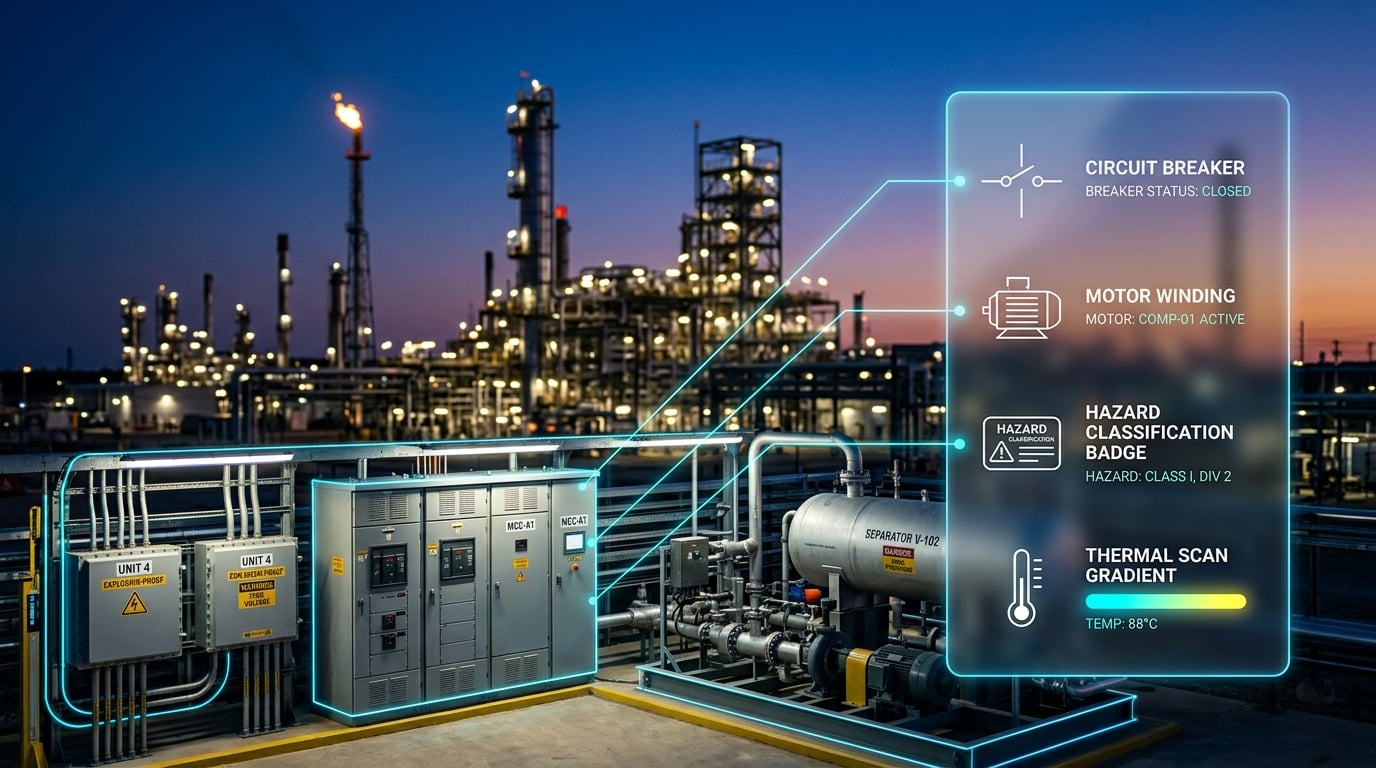
The instrumentation, control, and electrical systems built around a natural gas engine- parametric monitoring sensors, control panels, and SCADA or telemetry for tracking run hours and alarm history- play a direct role in how well a maintenance program can track engine condition and catch problems early.
Advanced Energy Services works with industrial and energy facilities across Louisiana, Texas, and the Gulf Coast on the instrumentation, electrical, and automation side of engine-driven systems, including control panels, monitoring instrumentation, and parts sourcing for I&E components. If your facility is evaluating how its engine monitoring, controls, or electrical systems support a natural gas engine maintenance program, contact Advanced Energy Services to discuss your instrumentation, electrical, or automation needs, or visit the Instrumentation & Electrical Services page to learn more about that scope of work.