


Industrial electrical services for oil and gas facilities in Lafayette, LA cover power distribution, motor control, hazardous-location wiring, instrumentation power, troubleshooting, and preventive maintenance. The work differs from commercial electrical service because much of it falls in classified areas, where equipment approval, sealing methods, and documentation requirements apply. Scope, cost, and schedule depend on site conditions that have to be assessed on location.
Key Takeaways
- Area classification drives equipment selection, not the other way around. Equipment must be approved for the specific class, division, gas group, and temperature code documented for that location — a Group D rating is not interchangeable with Group B.
- Louisiana licenses electrical contractors at a lower threshold than other trades. The Louisiana State Licensing Board for Contractors requires the Electrical classification for work exceeding $10,000, versus $50,000 for most other commercial classifications. Journeyman and master credentials are handled at the parish or municipal level.
- Electrical maintenance intervals are now condition-based, not calendar-based. NFPA 70B became a standard with mandatory language in 2023, and intervals are set from equipment condition, criticality, and operating environment.
- A tripped breaker is a diagnostic event, not a reset. Re-energizing before a qualified person determines the cause is one of the more common ways a recoverable fault becomes an equipment loss or an injury.
- Emergency response capability is something you arrange before the outage. Current one-lines, labeled equipment, a critical spares list, and a pre-existing service relationship do more for restoration time than the phone call itself.
Electrical problems at a production facility rarely announce themselves as electrical problems. They show up as a pump that will not restart, a compressor that trips on a hot afternoon, a well that stops reporting, or a breaker that holds for three days and then does not. By the time maintenance is involved, the question is usually operational: what is down, how long, and who can work in a classified area without creating a second problem.
This article covers what oil and gas operators in the Lafayette and Acadiana area should understand before scoping industrial electrical work: the standards that apply, the services involved, the failure modes worth planning for, and how to evaluate a contractor’s actual capability rather than their marketing.
Why Oil & Gas Facilities Require Specialized Electrical Expertise
The difference is not voltage. Plenty of commercial buildings run larger services than a tank battery does. The difference is that a meaningful share of the electrical scope sits inside areas classified for flammable atmospheres, feeds equipment whose failure has process safety implications, and lives in an environment that degrades terminations faster than an indoor plant floor.
An electrician who has never worked a classified area can install a fitting correctly and still create a hazard by placing a conduit seal on the wrong side of a boundary, leaving an unused opening unplugged, or torquing an explosionproof cover unevenly. None of those errors show up on a continuity check. They show up during an audit, or during an ignition event.
Electrical Systems That Support Upstream and Midstream Operations
Upstream and midstream sites concentrate their electrical load in a small number of systems:
- Artificial lift: rod pump, ESP, and progressive cavity systems, typically fed through a VFD or across-the-line starter, often at remote locations on utility service or generation.
- Compression: gas compressor packages with motor drivers, control panels, vibration and temperature shutdown devices, and emergency shutdown circuits.
- Pumping and transfer: pumps, injection pumps, and metering skids.
- Chemical injection: small-horsepower motors and heat trace, frequently in Division 2 areas.
- Measurement and telemetry: instrument power, solar and battery systems, RTU and PLC panels, and communication equipment.
- Facility power: service entrance, transformers, distribution panels, MCCs, and standby generation.
Each of these carries different consequences on failure. Losing a chemical injection pump is a maintenance item. Losing power to an emergency shutdown circuit or a fire and gas detection system is a safety event, and it should be treated with different urgency and different response procedures.
How Electrical Reliability Affects Production Uptime
Electrical failures are disproportionately represented in unplanned downtime because they tend to be fast, upstream of everything else, and hard to diagnose without instruments. A mechanical failure usually gives warning. A failed stab connection in an MCC bucket gives no warning at all until the motor stops.
The financial impact varies too widely to generalize. What it depends on is worth knowing before an outage rather than during one: production rate at the affected asset, restart time, whether the loss is deferred or permanently lost, downstream contractual commitments, and whether the failure triggers reportable conditions. Facilities that have worked that math in advance make faster and better decisions about repair versus temporary bypass versus waiting for a permanent fix.
Reliability itself is not something a contractor delivers by showing up. It comes out of design margin, equipment condition, maintenance history, environment, spare parts strategy, and accurate documentation. Service work supports it; it does not substitute for it.
Regulatory and Safety Standards for Oil & Gas Electrical Work
Three separate bodies of requirements apply to most industrial electrical work at a Louisiana oil and gas facility: the installation code (NEC, as adopted by the state), the workplace safety requirements OSHA enforces, and state and local licensing. Facilities with regulated pipeline assets may carry additional obligations under PHMSA; whether those apply depends on the specific asset and its jurisdictional status, and that should be confirmed rather than assumed.
Class I, Division 1 and Division 2 Hazardous Location Requirements
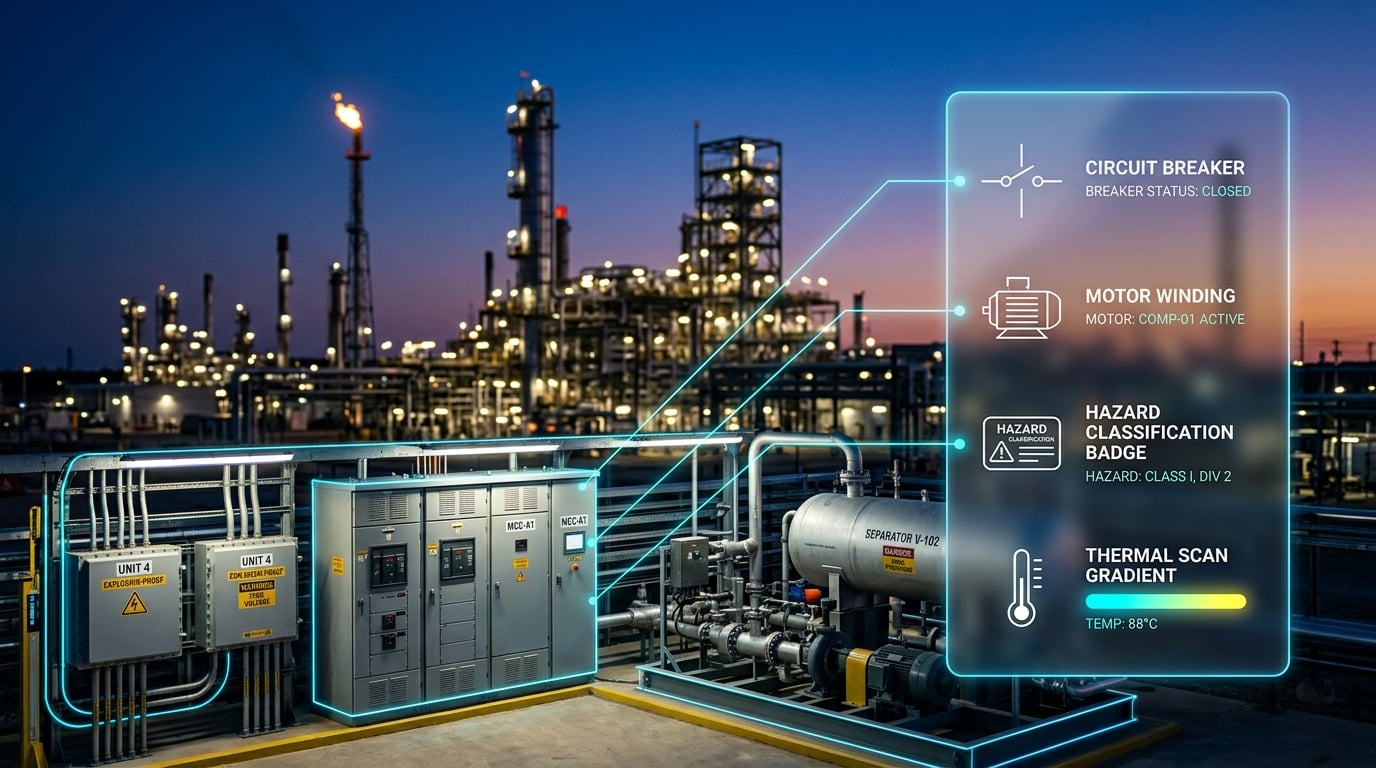
Class I locations are those where flammable gases or vapors may be present in ignitable quantities. Division 1 covers areas where that concentration exists under normal operating conditions. Division 2 covers areas where it exists only under abnormal conditions, such as a leak, a failed seal, or a ventilation failure adjacent to a Division 1 area.
Classification is a site-specific engineering determination, not something that can be assigned remotely or inferred from facility type. The petroleum industry commonly uses API RP 500 for division-based classification and API RP 505 for zone-based classification as the recommended practice behind those drawings.
Three points matter operationally:
- Documentation is required, and it has to be usable. Under OSHA 1910.307(b), classified area documentation must be available to those authorized to design, install, inspect, maintain, or operate electrical equipment at the location. If your classification drawings are in a filing cabinet in another office, they are not doing the job.
- Approval must match the specific atmosphere, not just the division. OSHA requires equipment approved for the ignitable or combustible properties of the specific gas, vapor, dust, or fiber present, marked with class, group, and operating temperature. Equipment rated for Group D gases is not acceptable in a Group B atmosphere.
- The rules run one direction. Equipment approved for a Division 1 location may be installed in a Division 2 location of the same class and group. The reverse is not permitted. General-purpose equipment may be installed in Division 2 only where the employer can demonstrate it is not a source of ignition under normal operating conditions.
Protection techniques are also division-specific. Explosionproof apparatus, intrinsic safety, and purged and pressurized systems are permitted in Division 1 where approved. Nonincendive circuits and equipment, hermetic sealing, and oil immersion are Division 2 techniques and cannot be substituted upward.
Explosion-Proof Equipment and Enclosures
“Explosionproof” is one of the most misread terms in industrial electrical work. It does not mean the enclosure keeps the flammable atmosphere out. It means the enclosure is built to contain an internal explosion and cool the escaping gases through machined flame paths so the surrounding atmosphere is not ignited.
That definition has practical consequences. The flame path is the safety function, which is why the condition of flange faces, the number and torque of cover bolts, thread engagement on threaded joints, and correctly located conduit seals all matter. The most common field problems are mundane: missing or substituted bolts, paint or corrosion on a flange surface, a cover cross-threaded during a rushed reassembly, an unused hub left open, or a seal fitting installed but never poured.
Enclosure ratings for corrosion, NEMA 4X, for instance, address water and corrosion ingress and are a separate question from hazardous-location approval. A stainless 4X enclosure is not automatically suitable for a classified area.
NEC, NFPA 70E, and Louisiana Licensing Requirements
NEC. Louisiana adopts the National Electrical Code statewide through the Louisiana Uniform Construction Code Commission. The commission approved adoption language for the 2023 NEC in July 2026, so confirm which edition your permit and inspection will be held to before finalizing a design that answer has been in transition.
NFPA 70E. NFPA 70E is a consensus standard rather than a law, but OSHA treats it as the recognized industry practice when evaluating electrical safety work practices. It drives the parts of your program that govern how people work: energized work justification and permits, approach boundaries, arc flash risk assessment, PPE selection, and training. The standard moved to its 2027 edition with revisions across Articles 90, 105, 110, and 120, so programs and training built against the 2021 or 2024 editions are worth reviewing.
Arc flash risk assessments should be reviewed on the interval the standard sets and updated whenever the electrical system changes — added generation, a new transformer, or a utility service change can invalidate the labels on your gear.
Licensing. Louisiana handles this differently than many states, and it catches procurement teams out. The Louisiana State Licensing Board for Contractors requires the Electrical classification for electrical work where the value exceeds $10,000 — a much lower trigger than the $50,000 threshold that applies to most other commercial classifications. Separately, Louisiana has no statewide journeyman electrician license; journeyman and master credentials are issued at the parish or municipal level. Verifying a contractor’s LSLBC license and classification takes about two minutes through the board’s public search, and it is worth doing before a bid, not after an inspection.
Core Electrical Services for Oil & Gas Facilities
Power Distribution, Switchgear, and Transformer Services
Distribution work covers service entrance equipment, transformers, switchboards, panelboards, feeders, and the protective devices between them. On existing facilities, the two scopes that generate the most value are usually the least visible: verifying that protective device settings still match the connected load and available fault current, and correcting documentation that no longer reflects the installation.
Load changes accumulate. A facility that has added a compressor, replaced a motor with a larger frame, or picked up a new utility transformer may be running protective settings established for a system that no longer exists. That is a coordination problem, and it affects both selectivity — whether a fault takes out one branch or the whole facility — and the incident energy numbers printed on your arc flash labels.
Transformer service includes visual and thermographic inspection, oil sampling and analysis on liquid-filled units, connection torque verification, and testing of grounding and protection. Interpreting the results requires trending, not a single data point.
Motor Control Center (MCC) Installation, Commissioning, and Retrofitting
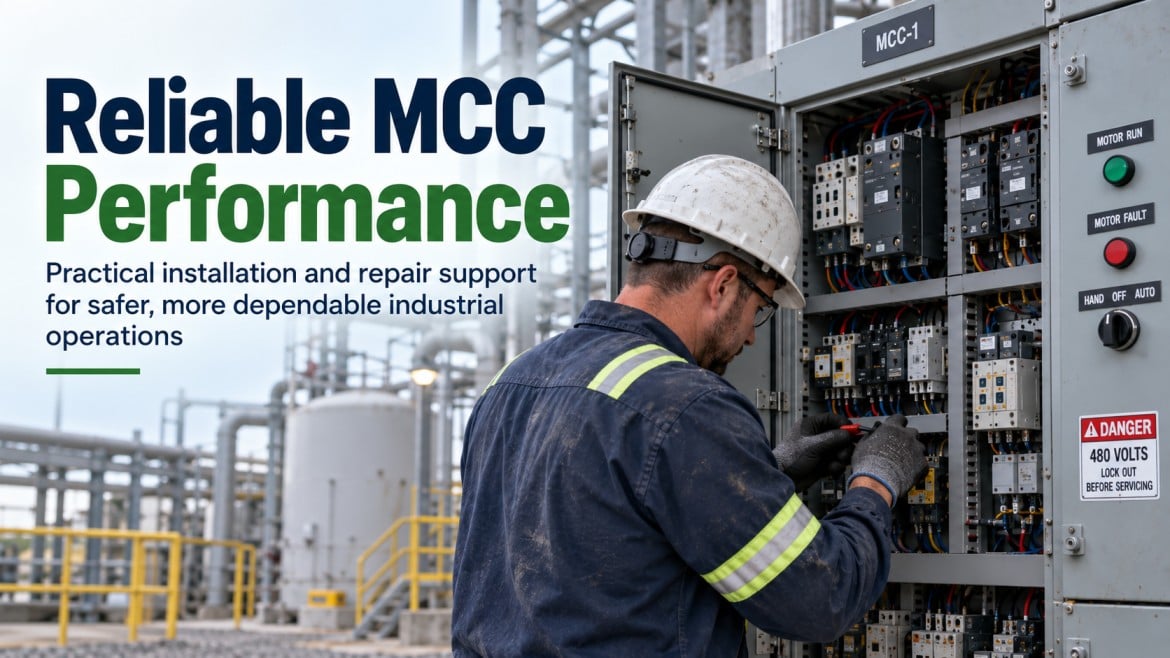
MCCs concentrate risk. They also concentrate the most common preventable failures in a production facility: loose or degraded stab connections, overheated bus joints, overload devices set to the wrong values after a motor change, contaminated or moisture-damaged buckets, and starter contacts worn past their useful travel.
Installation and retrofit work typically involves confirming available short-circuit current at the equipment location, verifying the MCC and its components are rated for it, coordinating bucket layouts with actual load requirements, and pulling and terminating motor circuits. Commissioning is where value is either captured or lost: insulation resistance testing, verification of overload settings against motor nameplate and service factor, rotation checks, control logic function testing, and confirmation that the as-built documentation reflects what was actually installed.
Retrofitting an existing MCC raises compatibility questions that need answering before parts are ordered: bucket dimensions and stab configurations vary by manufacturer and series, and structures from discontinued lines may need engineered adaptation rather than a catalog replacement.
Industrial Wiring and UL 508A Control Panel Fabrication
Field wiring in oil and gas facilities involves method selection driven by classification and environment: rigid metal conduit versus cable tray, appropriate fittings and seals, corrosion-appropriate hardware, and separation of power and signal circuits to limit induced noise on instrument loops.
UL 508A is the standard governing construction of industrial control panels in the United States. It addresses component selection, spacings, wiring methods, marking, and the determination of the panel’s short-circuit current rating. Two clarifications matter for buyers:
- Using UL-listed components does not make an assembled panel UL-labeled. The listing mark applies to the assembly and is applied by a shop operating under the applicable certification program.
- SCCR is a calculated value for the assembly, determined from the ratings of the components in the power circuit — it is not established by picking well-rated parts. The panel’s SCCR must equal or exceed the available fault current at its installed location, which is a facility-specific number.
When you specify a panel, ask what documentation comes with it: drawings, bill of materials, the basis for the SCCR determination, and test records.
Pump, Motor, and Artificial Lift Power Systems
Motor circuits carry most of the load at a production facility, and most of the electrical service calls. Scope typically includes feeder and branch circuit installation, disconnects, starters or VFDs, motor terminations appropriate to the area classification, and grounding.
VFD applications add considerations that get missed on retrofit projects. Drive-fed motors may require inverter-duty insulation depending on cable length and switching characteristics, shaft grounding or insulated bearings on some applications, appropriately shielded and terminated motor cable, and attention to the harmonic environment when several drives share a bus. Adding a VFD to an existing across-the-line motor is not always a like-for-like swap.
Artificial lift adds distance. Long feeder runs to remote well locations bring voltage drop, lightning exposure, and grounding into the design conversation in a way that a plant-floor motor circuit does not.
Compressor Station and Chemical Injection Skid Electrical Systems
Compressor stations combine a motor or engine driver, a control panel, shutdown instrumentation, and often gas detection into one package. The electrical scope usually splits between package terminations, site power feeding the package, and the interface between package shutdown logic and facility emergency shutdown systems.
That interface deserves careful treatment. Shutdown circuits, permissives, and alarms are not equivalent functions, and the distinction should be preserved in wiring and documentation. An alarm annunciates. A permissive prevents an action. A shutdown removes energy. Wiring that blurs those together makes troubleshooting slower and can quietly degrade a protective function.
Chemical injection skids are electrically smaller but almost always sit in classified areas, with small motors, heat trace circuits, and level instrumentation that need approval and sealing appropriate to the classification.
Electrical Support for Automation and Instrumentation
Automation systems fail electrically far more often than they fail logically. Loose terminations, grounding problems, marginal power supplies, and induced noise account for a large share of what gets reported as a “PLC problem” or a “SCADA problem.”
Field Wiring and Power for PLC, HMI, and SCADA Equipment
The electrical scope for control equipment covers panel power, UPS and DC power systems, I/O field wiring, cable routing and separation, panel grounding, and surge protection. It stops short of controller configuration and system integration, which are separate disciplines with their own testing requirements.
Grounding is where installations most often go wrong. Signal reference grounding, safety grounding, and shield termination practice serve different purposes, and combining them incorrectly produces intermittent faults that are hard to trace and easy to misattribute to a failing card. Shields terminated at both ends, or panels bonded through multiple paths, produce symptoms that look like equipment failure and are not.
Remote Telemetry and Wellhead Monitoring Installations
Remote sites depend on a power system before they depend on a communication system. Solar and battery installations need sizing against actual load and realistic worst-case recharge conditions, not nameplate figures. Undersized battery banks are a leading cause of sites that report reliably for most of the year and go quiet during a stretch of overcast weather.
Wellhead installations also concentrate lightning and surge exposure. Surge protection at power entry, communication lines, and instrument circuits, combined with a properly tested grounding electrode system, is cheaper than the equipment it protects.
For sites that connect back to a central control system, keep control network equipment off any path that exposes it directly to the public internet. Remote access to field controllers should run through controlled, authenticated pathways with segmentation between the control network and business systems; that architecture question is worth settling during installation rather than after.
Instrumentation and Automated Metering Connections
Instrument installation covers process connections, mounting, power and signal wiring, and enclosure and sealing appropriate to the classified area. The electrical portion is straightforward; the qualification is not.
Terminology is worth keeping straight, because it affects what you are actually buying. Calibration compares an instrument against a reference and adjusts it. Verification confirms it still reads within tolerance. A loop check confirms the signal path from field device to control system reads correctly end to end. A functional test confirms the resulting control or shutdown action occurs. A calibrated transmitter proves nothing about whether the loop is wired to the right input or whether the shutdown it feeds will actually trip. Custody transfer metering carries its own accuracy and documentation requirements beyond any of this.
For deeper coverage of control system programming and integration, that scope sits with automation and SCADA work rather than electrical service.
Common Electrical Problems in Oil & Gas Facilities
The symptoms below indicate categories of cause, not specific failures. Determining which one applies requires testing by qualified personnel, and no component should be replaced on the strength of a symptom alone.
Motor, Pump, and MCC Failures
A motor that will not start, trips on overload, or runs hot may point toward winding insulation degradation, bearing failure, a single-phasing condition from an open fuse or contact, a supply voltage or unbalance problem, an incorrectly set overload device, a mechanical load change, or a drive fault. These are distinguishable by measurement, insulation resistance testing, winding resistance comparison, voltage and current readings under load, thermographic inspection, and drive fault history, and largely indistinguishable without them.
Repeated failures of the same motor almost always point to something upstream or mechanical rather than to a run of bad motors. Replacing a third motor without investigating alignment, supply quality, or overload settings is a way to buy the same failure again.
Switchgear, Transformer, and Control Panel Problems
Nuisance trips, hot spots found on thermal scans, breakers that will not reset, and audible arcing or corona in a switch room are all conditions that require de-energized inspection and testing rather than operational workarounds.
Common contributors include loose or corroded terminations, contamination and moisture inside enclosures, hardened lubricant in breaker operating mechanisms on equipment that is never exercised, protective relay settings never re-verified after a load change, and cooling or purge system failures on enclosed equipment.
One point deserves emphasis: a device that has tripped on a fault should not be manually re-energized until a qualified person has determined it is safe to do so. Repeated reclosing into a fault is a well-documented cause of both equipment destruction and arc flash injury.
Moisture, Corrosion, and Gulf Coast Environmental Damage
South Louisiana facilities operate in sustained high humidity, and coastal and near-coastal sites see salt-influenced air. Both accelerate degradation of terminations, enclosure hardware, and exposed conductors.
Corrosion tends to enter through predictable paths. Conduit systems act as condensation routes into enclosures; conduit runs from warm to cool areas can move moisture into a panel that appears sealed. Failed or missing gaskets, unsealed hub entries, and enclosures without appropriate drains or breathers can accumulate water. Dissimilar metal contact at mounting hardware and lugs produces galvanic corrosion that shows up as high-resistance connections.
Facilities in sour service face an additional mechanism: hydrogen sulfide exposure attacks copper and silver surfaces, degrading contacts, terminations, and electronic assemblies even inside enclosures rated for weather. Sites with H₂S exposure often need conformal-coated electronics, sealed or purged enclosures, and shorter inspection intervals than the same equipment would need elsewhere.
Storm and Weather-Related Electrical Damage
Storm exposure creates two distinct problems: physical damage and water intrusion.
Physical damage from wind and debris is usually visible. Water intrusion is not, and it is where post-storm decisions go wrong. Electrical equipment that has been submerged or wetted breakers, switchgear, panelboards, motors, transformers, control panels should not simply be dried out and re-energized. Industry guidance, including NEMA’s guidance on evaluating water-damaged electrical equipment, generally calls for replacement or manufacturer evaluation of affected equipment, because contamination and internal corrosion compromise components in ways that a visual inspection and a megger reading will not reveal.
Lightning and surge events are the other common storm consequence, and they frequently damage instrumentation and control electronics without producing any visible sign at the panel.
Preventive Electrical Maintenance for Oil & Gas Facilities
NFPA 70B became a standard with mandatory language in 2023, which changed how electrical maintenance programs are evaluated by authorities having jurisdiction, insurers, and owners. Its structure is worth adopting regardless of enforcement: maintenance scope and interval are determined from an equipment condition assessment that accounts for the physical condition of the equipment, its criticality to operations, and its operating environment rather than from a uniform calendar interval applied to everything.
Routine Inspections, Testing, and Thermal Imaging
A working program usually combines several methods, because each finds different problems:
- Visual inspection: enclosure integrity, seals, corrosion, evidence of moisture, labeling, unused openings, physical damage.
- Infrared thermography: loose or high-resistance connections and load imbalance. Scans require equipment under representative load; a survey taken on a lightly loaded system can miss developing faults entirely.
- Ultrasonic inspection: arcing, tracking, and partial discharge in enclosed equipment, detectable before thermal signatures appear.
- Electrical testing: insulation resistance, contact resistance, protective device testing and injection, and ground system testing, performed de-energized under appropriate procedures.
Findings only become useful when they are trended. A single insulation resistance reading tells you very little; the same measurement taken annually on the same equipment tells you a great deal.
MCC, Switchgear, and Transformer Maintenance
For MCCs and switchgear, de-energized maintenance typically includes cleaning, inspection of bus and stab connections, verification of connection torque against manufacturer values, inspection and exercise of breaker mechanisms, lubrication per manufacturer instruction, overload and protective device verification, and inspection of enclosure sealing and environmental controls.
Torque verification is worth calling out specifically, because it is the item most often skipped and one of the more common root causes of thermal faults. It must be done to manufacturer values, not to feel.
Transformer maintenance varies by type. Liquid-filled units add oil sampling and dissolved gas analysis, which provide diagnostic information that no external inspection can. Dry-type units require attention to cleanliness and cooling airflow.
All of this work requires de-energization, isolation, and verification under the facility’s hazardous energy control procedures. A control system stop command, an HMI action, or a selector switch is an operational control; none of them is an energy-isolating device, and none of them substitutes for lockout/tagout under OSHA 1910.147.
Grounding, Bonding, and Backup Power Testing
Grounding systems degrade invisibly. Electrode resistance changes with soil moisture and corrosion, bonding connections loosen, and additions to a facility frequently miss the grounding scope entirely. Periodic ground resistance measurement and bonding continuity verification catch problems that otherwise surface as instrument noise, nuisance trips, or equipment damage after a surge event.
Static bonding at loading and transfer operations is a separate function with its own inspection requirement, and it should not be assumed to be covered by an equipment grounding check.
Backup power needs functional testing, not just a monthly run. Generators should be tested under load, transfer schemes should be exercised to confirm they actually transfer, and UPS battery systems need capacity testing rather than a look at the indicator panel. Standby systems that have never been load tested have a poor record of working the first time they are needed.
Building a Preventive Maintenance Schedule
A defensible schedule starts with an asset register: every piece of electrical equipment, its condition, its criticality, and its environment. Criticality ranking determines where the budget goes: equipment whose failure stops production or affects a protective function earns shorter intervals than equipment with redundancy or a low consequence of failure.
From there, the practical steps are: set intervals from condition and criticality rather than uniformly, align de-energized work with planned outages and turnarounds, define who performs each task and what qualification it requires, and specify the documentation each task produces.
Documentation is the part most programs underinvest in. Current one-line diagrams, panel schedules, equipment labeling, protective device settings, arc flash study results, and test history are what make the next troubleshooting call fast. Facilities without them pay for that gap during every outage, usually at emergency rates.
Electrical System Upgrades and Modernization
Aging electrical equipment does not automatically need replacement. The useful question is narrower: what is the current condition, is manufacturer support and parts availability still adequate, and what is the consequence if it fails before the next planned outage?
Retrofitting Aging Electrical Equipment
Several paths exist between “leave it alone” and “replace it,” and the right one depends on facility-specific factors:
- Maintain: equipment in good condition with available parts and adequate ratings.
- Targeted component replacement: replacing breakers, starters, or relays within existing structures where the structure remains serviceable.
- Retrofill or retrofit: installing current-generation components into existing enclosures, which can extend life without a full structural replacement.
- Phased replacement: sequencing sections across multiple outages to limit downtime and spread cost.
- Full replacement: where structures are degraded, ratings are inadequate for present fault current, or support has ended.
Two factors force the decision more often than age does. The first is available fault current: utility upgrades or added generation can raise it beyond what existing equipment is rated to interrupt, which is a safety issue rather than a preference. The second is parts availability, which should be confirmed against current manufacturer information rather than assumed from the equipment’s age.
Modernizing Industrial Control Panels
Panel modernization usually pairs with equipment replacement rather than standing alone. Common drivers include components no longer supported, enclosure or sealing no longer appropriate for the area classification, SCCR inadequate for the installed location, and documentation that no longer matches the panel.
When a panel is rebuilt, the opportunity worth taking is documentation: accurate drawings, consistent labeling, and a bill of materials that lets someone source a replacement part at 2 a.m. without reverse-engineering the wiring.
Improving System Reliability and Efficiency
Upgrades can reduce identified failure risk where they address a specific, diagnosed cause, replacing equipment with a known condition problem, correcting protective coordination, adding surge protection at documented exposure points, and improving enclosure environmental protection in corrosive service.
Efficiency claims deserve more caution. VFDs can reduce energy consumption on variable-torque loads such as centrifugal pumps and fans, where flow requirements vary. On constant-torque or constant-load applications, the savings may be small or absent, and the drive introduces its own losses and maintenance requirements. Whether a specific installation benefits depends on the load profile, which should be measured rather than assumed. Define what you intend to measure before the project, and baseline it.
Emergency Electrical Support and Downtime Prevention
How Electrical Failures Impact Oil & Gas Production
Electrical failures propagate quickly because most process equipment sits downstream of them. A distribution-level fault can stop compression, lift, and transfer at once, and restart is rarely instantaneous; sequencing, purging, and process stabilization take their own time after power is restored.
Some failures carry consequences beyond production. Loss of power to shutdown systems, gas detection, or containment equipment is a safety condition. Loss of power to metering affects measurement records. These should be prioritized differently from a stopped transfer pump, and that prioritization is worth defining before it is needed.
When a Facility Needs Emergency Electrical Service
Conditions that warrant immediate qualified response rather than a scheduled call:
- Burning odor, smoke, or visible damage at electrical equipment
- Audible arcing, buzzing, or crackling from switchgear or an MCC
- A protective device that trips repeatedly or will not hold
- Water intrusion into energized equipment
- Loss of power to shutdown, detection, or other safety-related systems
- Ground fault indication on an ungrounded or resistance-grounded system
- Equipment damage following a storm, flood, or lightning event
In each case, the correct immediate action is isolation under the facility’s procedures and escalation to qualified personnel, not repeated reset attempts, and not opening energized equipment to look for the problem.
Emergency Response Planning, Backup Power, and Critical Spare Parts
Restoration speed is determined mostly by decisions made months earlier. The items that matter:
Documentation. Current one-lines, panel schedules, equipment labeling, and protective settings. Troubleshooting an unlabeled MCC costs hours that no response time commitment recovers.
Critical spares. Identify long-lead and single-point-of-failure items — specific breaker frames, starter buckets, transformers, drives — and decide deliberately whether to stock, contract, or accept the lead time. Stocking everything is not the goal; knowing which items would extend an outage from hours to weeks is. Sourcing decisions for industrial electrical and automation parts are easier to make with a facility’s actual nameplate data in hand than during an outage.
Backup power that has been tested under load. Covered above, and repeatedly, the difference between a short interruption and a long one.
A pre-existing relationship. A contractor who already has site access, safety orientation, prequalification, and familiarity with your equipment starts work faster than one being onboarded during an emergency.
Emergency Field Support vs. Long-Term Maintenance Contracts
These are different commercial arrangements addressing different risks, and most facilities use both.
Emergency support is reactive and priced accordingly: unplanned mobilization, after-hours labor, expedited freight, and frequently a temporary repair followed by a permanent one later. Its cost is real, but its availability depends on the relationship you have before the call.
A maintenance agreement covers planned scope: inspections, testing, documented findings, and scheduled corrective work. It does not eliminate emergencies, and any contractor suggesting otherwise is overselling. What it does is reduce the number of failures that arrive without warning and shorten the diagnostic phase of the ones that do.
When comparing agreements, look past the rate sheet at what is actually defined: scope inclusions and exclusions, response and escalation commitments in writing, whether parts and travel are included, what documentation is delivered after each visit, and what qualifications the assigned personnel hold.
Industrial Electrical Challenges Unique to Lafayette and Acadiana
Why Local Response Times Matter for Production Facilities
Acadiana production facilities are dispersed. Sites across Lafayette, Vermilion, Iberia, St. Martin, and surrounding parishes may be an hour or more from a contractor’s shop, on parish roads that are slower than the map suggests, and reachable only during daylight in some cases.
That distance affects more than arrival time. It affects whether a technician can return the same day with the right part, whether a diagnostic visit and a repair visit collapse into one trip, and how much a two-hour job actually costs once travel is counted. It is a reasonable thing to ask about directly when evaluating contractors.
Regional Parts Availability and Field Support
Lead time drives outage length more often than labor availability does. Common items are usually obtainable regionally; specific breaker frames, MCC buckets matched to an existing structure, drives, and transformers frequently are not.
Before an outage, it is worth identifying which of your critical components fall into the second category and confirming what current availability actually looks like; availability shifts, and last year’s answer may not hold.
Supporting Oil & Gas Operations Across Acadiana
Practical support in this region means being able to work across the mix that Acadiana facilities actually run: older MCCs and switchgear alongside recent drives and control panels, classified-area installations, remote sites on solar and battery power, and equipment from a range of manufacturers rather than a single line. Familiarity with what is installed locally shortens diagnosis on equipment that no longer has a current manual.
What Industrial Electrical Services Cost in Lafayette, LA
Published pricing for industrial electrical work is not meaningful, because the scope varies more than the labor rate does. What is useful is understanding which variables move the number, so you can scope accurately and compare bids on equal terms.
Factors That Affect Service Costs
- Scope definition. The largest variable. A well-defined scope with accurate drawings prices tighter than an open-ended troubleshooting call.
- Classified area work. Hazardous-location requirements affect materials, methods, permitting, hot work considerations, and labor hours.
- Access and outage conditions. Whether work can be done during an existing outage, requires a dedicated shutdown, or must be sequenced around production has a substantial effect.
- Engineering. Short-circuit studies, coordination studies, arc flash analysis, and drawing updates are separate deliverables from installation labor.
- Materials and lead time. Availability of specific equipment and whether expedited freight is needed.
- Travel and mobilization. Site distance, crew size, and whether equipment must be brought to a remote location.
- Site requirements. Safety orientation, prequalification, permit systems, and standby requirements consume hours that appear in the bid.
- Documentation and testing. Test reports, as-built updates, and closeout documentation are worth specifying, because a bid that omits them is not the same scope as one that includes them.
When comparing quotes, confirm each includes the same testing, documentation, and engineering deliverables. Bid spreads on industrial electrical work are more often scope differences than rate differences.
Emergency Repair vs. Preventive Maintenance Contract Pricing
Emergency work carries premium rates for after-hours and unplanned mobilization, and often involves a temporary repair followed later by a permanent one, which means two mobilizations for one failure. Expedited freight, overtime, and diagnostic time on undocumented equipment add to it.
Maintenance agreements price scheduled labor at planned rates with known scope. The comparison worth making is not agreement cost versus emergency rate, but total annual cost including the emergency events you would still expect, against the same facility without a program. That calculation depends on your equipment condition, age, criticality, and environment, and it is specific enough that it should be worked with your own numbers rather than borrowed from an industry average.
How to Choose an Industrial Electrical Contractor
Licensing, Insurance, and Hazardous Location Expertise
Verify rather than assume:
- LSLBC license and classification. Confirm the Electrical classification and current status through the board’s public license search. Remember the $10,000 threshold for electrical work.
- Parish and municipal credentials. Journeyman and master licensing is local in Louisiana; confirm the requirements for your jurisdiction.
- Insurance. Certificate of insurance with limits appropriate to your requirements, workers’ compensation, and any additional insured or waiver of subrogation provisions your contracts require.
- Safety prequalification. Most oil and gas operators require contractors to be current in a third-party prequalification system; confirm status before mobilization rather than at the gate.
- Hazardous location capability. Ask specific questions: how they verify equipment markings against your classification documentation, their conduit sealing practice, their energized work policy, and how their crews integrate with your hazardous energy control procedures.
That last group of questions is the most revealing. A contractor comfortable in classified areas answers them concretely and quickly.
Oil & Gas Industry Experience and Emergency Availability
Ask what equipment they routinely work on, whether they have worked on facilities configured like yours, and how they handle work that crosses into instrumentation and controls. A large share of oil and gas electrical work touches both, and coordination between separate contractors is where scope gaps appear.
On availability, get specifics in writing rather than assurances: what hours are covered, what the escalation path is, who answers after hours, and what response commitment they will actually put in an agreement. Verbal availability claims are common in this industry and worth converting into contract language.
Frequently Asked Questions
What electrical standards apply to hazardous oil and gas locations?
The NEC, as adopted in Louisiana, governs installation requirements. Articles 500 through 506 address classified locations. OSHA 1910.307 sets the workplace requirements for equipment in hazardous locations, including approval for the specific class, division, group, and temperature, and documentation of area classification. NFPA 70E governs work practices, and API RP 500 or RP 505 are commonly used as the basis for classification drawings. Pipeline-regulated assets may carry additional PHMSA requirements depending on jurisdictional status.
How often should oil and gas electrical systems receive preventive maintenance?
There is no single correct interval. NFPA 70B sets intervals based on an equipment condition assessment that accounts for physical condition, criticality to operations, and operating environment. In practice, that means critical equipment in corrosive or humid service is inspected and tested more frequently than redundant equipment in a controlled environment, and intervals should be documented with the reasoning behind them rather than adopted from a generic table.
How quickly can a contractor respond to an emergency in Lafayette?
It depends on distance to your site, crew availability at that moment, and whether the contractor already has site access and prequalification in place. Rather than accepting a general claim, ask for a specific commitment in an agreement, and reduce your own dependence on response time by keeping documentation current, equipment labeled, and critical spares identified.
Should a facility have a long-term electrical maintenance contract?
It depends on equipment age and condition, criticality, in-house maintenance capability, and how much unplanned downtime costs your operation. Facilities with aging distribution equipment, limited internal electrical staff, or high downtime consequences generally get more value from an agreement. Facilities with newer equipment and strong internal capability may only need periodic testing and specialist support. Either way, a maintenance agreement reduces the frequency of surprise failures; it does not eliminate them.
Can electrical upgrades be performed without shutting down production?
Sometimes, partially. Work that can be isolated to a redundant feeder, a spare section, or equipment that can be taken out of service individually may proceed with limited production impact, and temporary power or phased cutover can reduce outage duration. But de-energization is the default requirement for most electrical work, and NFPA 70E permits energized work only in limited circumstances with justification and an energized electrical work permit. Any contractor who treats energized work as a routine convenience for avoiding downtime is a risk to your facility.
Get Reliable Industrial Electrical Support in Lafayette, LA
Most electrical decisions at a production facility come down to the same set of questions: what condition is the equipment actually in, what does the classification documentation require, which failures would extend an outage from hours into weeks, and what should be maintained versus repaired versus replaced. Those answers are site-specific. They come from inspection, testing, and a look at your drawings, not from a general article.
Advanced Energy Services provides SCADA and automation, instrumentation and electrical (I&E), and parts and sales support to oil and gas, industrial, utility, and infrastructure operations across Louisiana, Texas, and the surrounding Gulf Coast region. Our office is at 302 Commercial Parkway in Broussard, just outside Lafayette, which puts our crews close to Acadiana production facilities.
If you are planning a maintenance scope, evaluating an upgrade, working through a recurring electrical problem, or sourcing a hard-to-find component, we are glad to talk through the specifics with you.
Call 337-330-2797 or email sales@advancedenergyla.com to discuss your facility’s electrical requirements.