


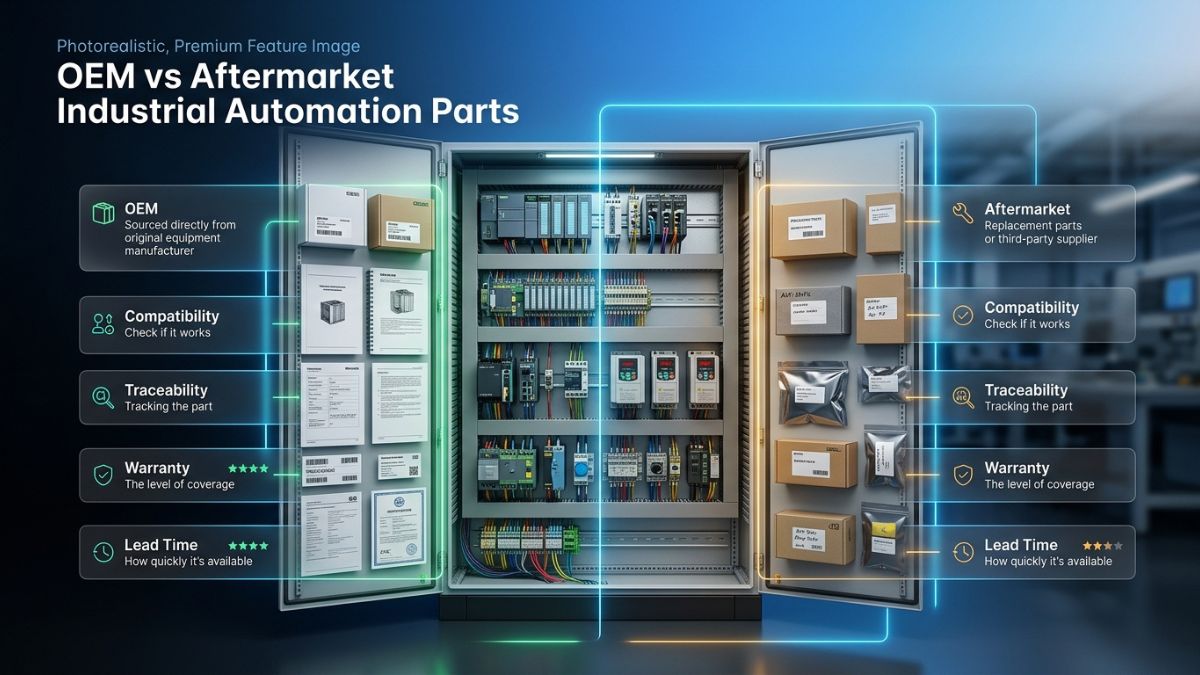
OEM parts come from the original manufacturer or its authorized channel, with factory warranty and revision control. Aftermarket parts come from independent suppliers, often at lower cost or shorter lead time. OEM fits safety-critical, warranty-covered, and certified applications. Aftermarket fits non-critical spares and obsolete equipment. The right answer depends on component criticality, verified compatibility, and how much you can document.
Key Takeaways
- Criticality decides the sourcing route, not price. Ask what stops, degrades, or becomes unsafe when the part fails.
- A matching catalog number is not proof of compatibility. Series, firmware, option codes, and approvals all belong in the specification.
- Consumer warranty protections do not extend to industrial equipment. Your coverage is whatever the purchase contract says.
- Aftermarket risk is managed through traceability and functional testing, not through supplier reputation alone.
- Obsolete is not the same as unavailable. Repair, surplus, refurbished, and migration are four separate paths with different risks.
A failed I/O module on a Friday afternoon changes the sourcing conversation. The authorized distributor quotes a four-week lead time. An independent supplier has the same catalog number on the shelf and can ship today. The part is not the decision. The decision is whether that specific component, in that specific application, can accept the risk that comes with an unverified supply chain.
This guide covers how OEM and aftermarket parts actually differ, where each one belongs, how to identify the correct part before you request a quote, and how to verify what arrives. It also covers obsolete components, supplier evaluation, and the logistics that affect delivery to Louisiana industrial sites.
What Are OEM and Aftermarket Industrial Automation Parts?
These terms get used loosely in purchasing conversations, and the imprecision causes real problems. Two suppliers can both say “OEM part” and mean different things. Getting the definitions straight is the first step in comparing quotes that look similar on paper.
OEM Parts Defined
An OEM part is manufactured by the company whose brand appears on the component, or by a contract manufacturer under its control. It reaches you through the manufacturer directly or through an authorized distributor. The defining attribute is an unbroken chain of custody from the factory to your receiving dock.
That chain is what delivers the practical benefits. You get the current hardware revision, factory warranty terms, published specifications, firmware support, and access to manufacturer technical assistance. You also get predictable handling and storage, which matters more for electronics than most buyers assume.
One caution on terminology. In machine building, “OEM” often refers to the company that built your production equipment, not the component manufacturer. A packaging machine builder is an OEM. Allen-Bradley is also an OEM. When a supplier offers an OEM part, confirm which manufacturer they mean.
Aftermarket Parts Defined
Aftermarket covers components sold outside the authorized channel. That category contains several very different things. It includes independent distributors and brokers holding genuine excess stock. It includes third-party manufacturers producing functional equivalents. It also includes parts pulled from decommissioned equipment and resold.
Aftermarket is a channel description, not a quality grade. A genuine, factory-sealed drive sitting in a broker warehouse is aftermarket by channel. A third-party clone of that same drive is aftermarket by manufacturer. Those two items carry completely different risk profiles and should never be evaluated the same way.
When you request a quote, ask the supplier to state which it is. Genuine manufacturer product from independent stock, third-party equivalent, surplus, or refurbished. A supplier who will not answer that question clearly has told you something useful.
OEM vs Aftermarket vs Surplus vs Refurbished
These four categories overlap in conversation and separate cleanly in practice. The table below shows how they differ on the factors that matter during sourcing.
| Category | Where it comes from | Condition | Warranty | Typical fit |
|---|---|---|---|---|
| OEM / authorized | Manufacturer or authorized distributor | New, current revision | Factory warranty terms | Safety functions, new installations, warranty-covered assets |
| Aftermarket equivalent | Third-party manufacturer | New | Supplier warranty only | Commodity items in non-critical service |
| Surplus | Independent channel excess stock | New and unused, date code may be old | Supplier warranty, often short | Obsolete parts, cost-sensitive spares |
| Refurbished | Repair facility | Used, repaired and tested | Supplier warranty, terms vary | Legacy systems, exchange programs |
Refurbished carries a specific meaning worth defending. It implies documented work was performed, usually including replacement of wear items and testing against a defined procedure. A part described as “tested” or “pulled working” has not been refurbished. Ask for the repair report before you accept the label.
OEM vs Aftermarket Industrial Automation Parts: Key Differences
The comparison below applies across component families. Weight each factor according to what the part does in your process, not according to what it costs.
Upfront Price vs Total Cost of Ownership
Aftermarket pricing is usually lower, sometimes substantially. The purchase price is only one input. Total cost includes verification labor, bench testing time, freight and expedite charges, and the cost of a second attempt if the first part does not work. It also includes the value of a spare that sits on your shelf for three years and turns out to be incompatible when you finally need it.
On a general-purpose proximity sensor, the price difference dominates, and the calculation is simple. On a drive controlling a production line, a single failed startup can erase the savings across a dozen purchases. The variables to estimate are your replacement labor hours, restart time, production rate during the outage, and scrap generated on restart.
Do not treat downtime cost as a fixed hourly number pulled from an article. It depends on your production rate, product value, restart sequence, contractual commitments, and what happens downstream. Calculate it for your own line before you use it in a sourcing decision.
Compatibility, Firmware, and Revision Requirements
The catalog number is a starting point. Full compatibility can depend on hardware series or revision letter, firmware version, communication protocol and its version, I/O mapping, memory size, licensing, and safety approvals.
Firmware causes more failed swaps than anything else in controller and drive replacement. A controller shipped with newer firmware may require project conversion before it accepts your existing program. An older unit may not support an instruction or feature the program uses. Neither problem is visible in the part number.
Before sourcing, record the series letter and firmware revision from the installed device. Ask the supplier to confirm the same values on the unit they will ship; in writing, if the program requires a specific version, state that requirement in the request for quote instead of discovering it during the outage.
Quality, Reliability, and Expected Service Life
Aftermarket components are not automatically less reliable. The real difference is variance. The authorized channel gives you known storage conditions, electrostatic discharge control, handling practices, and a recent date code. The independent channel can match all of that when the supplier maintains a documented quality system, or match none of it when they do not.
Age matters for stored electronics in a way that catches buyers off guard. Electrolytic capacitors in drives and power supplies degrade on the shelf, not just in service. Several manufacturers publish reforming procedures for drives stored beyond a stated period. If you buy surplus stock with an old date code, follow the manufacturer’s instructions for that product before energizing it in the plant.
Legacy processor modules with lithium memory batteries deserve the same attention. A surplus module that has been on a shelf for years may arrive with a depleted battery and no memory retention. Plan to replace the battery on receipt and record the date.
Warranty and Manufacturer Support
Three separate things get confused here. There is the warranty on the part, the warranty on the equipment the part goes into, and your entitlement to manufacturer technical support. They are governed by different agreements and can be affected differently by a non-OEM purchase.
Manufacturer technical support and firmware downloads are often tied to registered serial numbers or an active support contract. A genuine component bought through an independent channel may still leave you outside that entitlement. Confirm what support you retain before you assume the part is equivalent.
An independent supplier warranty is a contractual promise from that supplier, backed by their ability to honor it. Duration matters less than coverage. Most warranties cover replacement of the failed part and exclude consequential losses, including your downtime. Read what is excluded, not just the term length.
Availability and Lead Times
Authorized channel availability tracks manufacturer production and allocation. During supply constraints, published lead times move and can move sharply. That constraint is the structural reason the independent market exists at scale.
Independent suppliers can hold stock the factory no longer builds. For discontinued products, they are frequently the only source of new-condition parts. For active products during an allocation period, they may hold inventory the authorized channel has already committed.
During an outage, quote both channels in parallel rather than sequentially. Waiting for the authorized quote to come back before contacting independent suppliers costs hours you cannot recover.
Documentation and Traceability
Traceability means a documented path from the manufacturer to you. At minimum, ask for the source of supply, date code, packaging condition, and any inspection or test records the supplier holds. For high-value items, ask for it before the purchase order rather than with the shipment.
For facilities running processes covered by OSHA process safety management, this stops being paperwork. The mechanical integrity requirements at 29 CFR 1910.119(j) require employers to assure that maintenance materials, spare parts, and equipment are suitable for the process application in which they are used. A supplier who cannot tell you where a part came from makes that assurance harder to document.
OEM vs Aftermarket by Component Type
Risk is not distributed evenly across a control system. The sections below cover where the exposure concentrates in each component family.
PLCs, I/O Modules, and Safety Controllers
Processors carry the highest compatibility risk in this group. Firmware revision, memory configuration, and project file version all have to align. A processor that boots and communicates can still refuse the program you need to load.
Safety controllers, safety I/O, and safety relays sit in a different category entirely. These devices carry functional safety certification tied to a specific part number and firmware. Substituting an uncertified device, or a different certified revision, changes the assumptions behind the safety function. Any change to a safety instrumented function should go through your management of change process and be verified by qualified personnel before the function is returned to service.
Standard digital and analog I/O modules are the most reasonable aftermarket candidates in this family. They are simpler, well understood, and straightforward to test on a bench before installation. Confirm the module series, since terminal arrangement and diagnostic behavior can change between revisions.
HMIs and Operator Panels
With operator panels, the risk lies in software more than hardware. Runtime version, license transfer, project compatibility, and the underlying operating system image all determine whether your application loads. Two physically identical panels can behave differently because of the runtime they shipped with.
Used panels also arrive with consumed life. Touchscreen digitizers and backlights are wear items, and a panel pulled from a decommissioned line may have years of service behind it. Ask about the source and condition, and inspect the screen surface and backlight uniformity on receipt.
A newer OEM panel is not always the simpler path. If the replacement requires converting the project to a new runtime, you have a small engineering project rather than a swap. Decide that before the outage window, not during it.
VFDs, Servo Drives, and Motion Control
Drives are the highest-value aftermarket category and, for the same reason, the one where counterfeit and misrepresented refurbished units concentrate. They also carry the most specification detail.
Matching horsepower and voltage is not sufficient. Verify frame size, output current rating, overload class, control mode support, option card and communication module, encoder feedback type, dynamic braking provisions, input filtering, and enclosure rating. A drive that matches on the nameplate can still be wrong for the application.
Servo drives add another constraint. Drive and motor form a matched pair with feedback and tuning tied to specific models. Firmware version affects motion behavior directly. Treat servo replacement as a system question rather than a component swap.
Where a drive frame is no longer manufactured, a repair facility that documents which components it replaced and tests at rated load can be a reasonable path. Ask what their standard rebuild includes and whether they test under load or only power it up.
Sensors, Encoders, and Instrumentation
Instrumentation requires more precision than the phrase “same range” suggests. Distinguish between devices that measure, indicate, transmit, switch, or alarm. Those functions are not interchangeable even when the process variable is the same.
Process transmitters carry hazardous location approvals and specific wetted material specifications. Substituting a transmitter with a nominally identical range can change the wetted material, accuracy class, or approval marking. In a classified area, the approval marking is part of the specification and not an optional detail.
Encoders need resolution, output type, interface, shaft or flange configuration, and environmental rating confirmed. Absolute and incremental encoders are not substitutes for each other regardless of pulse count.
One process point worth stating plainly. After any instrument replacement, calibration confirms the device responds correctly against a reference. It does not prove the loop is correct. A loop check verifies the signal path through to the control system and the operator display, and that is a separate activity.
Power Supplies and Networking Components
Power supplies look like a commodity and often are, within limits. Beyond voltage and current, check hold-up time, inrush characteristics, derating at your actual enclosure temperature, and behavior in redundant or parallel configurations. A supply rated 24 VDC at 10 A can still fail early in a hot panel if it was rated at 25 degrees Celsius ambient.
Industrial switches carry a configuration risk that hardware specifications do not show. Managed and unmanaged switches are not interchangeable. Ring protocols, multicast filtering, VLAN configuration, and port settings all live in the device configuration. Swapping in an identical managed switch without the configuration file will not restore the network.
Store configuration backups alongside the spare part record. That practice converts a network switch from a multi-hour troubleshooting event into a ten-minute replacement.
When to Choose OEM vs Aftermarket
The decision becomes repeatable once you frame it around consequence rather than around cost.
Choose OEM: Safety-Critical Systems, Core PLCs, and Warranty-Covered Equipment
Some applications do not have enough margin to absorb supply chain uncertainty. Stay in the authorized channel for these:
- Any component in a safety instrumented function, safety relay circuit, light curtain, or emergency stop system.
- Devices carrying hazardous location approvals, where the marking is part of the specification.
- Equipment still inside its warranty period or covered by an OEM service agreement.
- New installations and expansions, where revision consistency across the system reduces future troubleshooting.
- Parts entering a process covered by process safety management, where suitability must be documented.
- Any component whose failure consequence is injury, a release, or regulatory exposure.
The common thread is that the cost of being wrong is not measured in dollars.
Choose Aftermarket: Non-Critical Components, Cost-Sensitive and Urgent Needs
Aftermarket sourcing is a normal, defensible practice in the right places. Reasonable candidates include standard I/O modules, general-purpose sensors, power supplies feeding non-critical loads, switches on non-critical network segments, and low-consequence spares you hold in quantity.
It is also the practical answer for legacy components the factory no longer builds, and for emergency replacement when authorized lead time exceeds acceptable downtime.
One caution on urgency. Time pressure justifies the channel, not skipping verification. If you install an unverified part during an outage because you had no alternative, log it and plan to replace or validate it at the next scheduled shutdown. An undocumented part in a running system is a problem that surfaces later.
Choose a Hybrid Strategy: Risk-Based Sourcing Across Your Spare Parts Portfolio
Most facilities end up here, and the ones who do it well have written the rules down. Build the policy around criticality classes rather than around individual parts.
A workable structure looks like this. Class A covers production-stopping or safety-related components, sourced through the authorized channel only, with a spare held on site. Class B covers components that degrade operation without stopping it, where OEM is preferred and verified aftermarket is acceptable. Class C covers redundant and non-critical components, where aftermarket is acceptable with basic verification.
The value of writing it down is consistency. Buyers make sourcing decisions at times when the specifying engineer is not available. A documented rule set gives them a defensible answer at 11 pm. Review the classification annually and after any failure that surprised you.
How to Identify the Correct Part Before Sourcing
Most sourcing errors are identification errors. They happen before anyone contacts a supplier.
Verify Part Number, Model, and Revisions
Take the information from the installed device nameplate, not from the drawing set alone. Drawings drift after modifications, and the panel in front of you is the current record.
Capture the catalog number, series or revision letter, firmware version, serial number, date code, and any option or configuration codes. Photograph the nameplate and attach the image to the asset record. For controllers and drives, firmware version is usually available through the programming software or a diagnostic screen during normal operation.
Gathering this information should never involve opening an energized enclosure. Work inside industrial control panels requires qualified personnel and appropriate energy control procedures. Collect what you can from documentation and diagnostics, and schedule the rest with the crew who can do it safely.
Confirm Electrical, Mechanical, and Protocol Specifications
Once you have the number, confirm the specification behind it. Supply voltage and tolerance, current draw, signal type and range, isolation requirements, terminal or connector type, mounting footprint, ambient temperature rating, enclosure rating, and hazardous area approval where applicable.
Protocol deserves specific attention because the name alone is not enough. Two devices that both support Modbus may differ in RTU versus TCP implementation, register mapping, or serial parameters. Confirm what the master expects and what the replacement provides, at the level of the actual configuration.
Compare Approved Alternates and Cross-Reference Parts
Manufacturer and distributor cross-reference tools are useful for generating candidates. Treat the output as a list to verify, not as an answer. Cross-reference logic typically matches on primary specifications and misses application-specific requirements.
Where a manufacturer publishes a formal migration or conversion path for a discontinued product, that documentation carries more weight than a generic cross-reference. It usually addresses wiring, programming, and mounting differences the cross-reference does not mention.
If your facility has an approved alternates list from the original integrator or machine builder, use it before improvising. Someone already did the compatibility analysis, and repeating it under time pressure rarely improves on the result.
Prepare a Bill of Materials for RFQ
A request for quote without a proper bill of materials produces quotes that cannot be compared. Include catalog number, description, series and firmware requirement, quantity, acceptable condition, required certifications, required documentation, need-by date, and acceptable alternates.
Stating acceptable condition is the line item most buyers leave out. Without it, one supplier quotes new authorized stock and another quotes refurbished, and the price difference looks like a discount rather than a different product.
Include the parent equipment and the application when you want the supplier to catch your errors. A supplier who knows the drive runs a specific pump can flag a mismatch that a bare catalog number would hide.
How to Verify Aftermarket Part Quality and Authenticity
Verification effort should be proportional to consequence. A twenty-dollar sensor for a non-critical indication does not need the same scrutiny as a drive controlling a main process pump.
Check Serial Numbers, Labels, and Manufacturer Markings
Start with the label. Compare print quality, font consistency, alignment, and adhesive against a known-good unit from your stores. Manufacturer labeling is highly consistent, and small deviations are meaningful.
Check internal agreement as well. The catalog number, series marking, firmware label, and any date code should agree with each other and with what was quoted. Overlabeling, missing markings, or a label applied over another label warrants rejection or escalation to the supplier.
Some manufacturers will verify a serial number through their support channel. For high-value components, that check is worth the phone call before the part goes into a panel.
Verify Packaging, Documentation, and Manufacturing Date
Original sealed packaging with an intact antistatic bag and a manufacturer part label supports authenticity. Generic boxes, mixed packaging, or a resealed bag are not proof of a problem, but they change what you should check on arrival.
Date code matters for anything containing capacitors or batteries, and it should be requested before purchase rather than discovered at receiving. Ask the supplier to confirm the date code range they will ship.
Request the documentation set as well. Installation manual, wiring information, and any certificate of conformance the supplier can provide. A supplier who ships genuine product usually has no difficulty providing paperwork.
Request Traceability and Quality Certifications
Ask two questions of every independent supplier. Where did this part come from, and what quality system governs how you handle it?
In electronic component distribution, SAE AS6081 sets requirements for counterfeit avoidance, detection, and disposition by independent distributors. A related standard, SAE AS6171, defines the laboratory test methods used to disposition suspect parts. The current revision of AS6081 refers testing requirements to AS6171 rather than defining its own methods.
These standards were developed in aerospace and defense supply chains, and most industrial distributors will not be certified to them. That is not a disqualification. Asking whether a supplier operates a documented counterfeit avoidance program is still a fair screening question, and the quality of the answer tells you something. Ask about electrostatic discharge handling and storage conditions in the same conversation.
Identify Signs of Counterfeit or Reworked Components
No single indicator is conclusive, but several patterns recur. Sanded or resurfaced housings, inconsistent case texture, mismatched fasteners, markings that smear under solvent, connector wear on a part sold as new, evidence of prior heat on a circuit board, non-original conformal coating, and internal date codes that disagree with the external label.
Agree on inspection terms before you buy. Opening a device to inspect it may void your return rights, so establish with the supplier what inspection is permitted while the part remains returnable.
When you find a suspect part, escalate it rather than quietly returning it. A quiet return puts the part back into circulation for the next buyer. Reporting it to the supplier and the manufacturer gives the supply chain a chance to see the pattern.
Require Functional Testing for High-Risk Parts
For controllers, drives, safety devices, and anything difficult to replace a second time, test before installation. Testing before the outage window converts an unknown into a known condition while you still have options.
Practical bench testing includes powering the device up, running the manufacturer’s self-test, loading a representative program, exercising input and output points, running a drive on a small test motor through its speed range, and confirming communication using the actual protocol and parameters the plant uses.
Testing needs qualified personnel and appropriate equipment. Document the result and file it with the spare part record, including who tested it and when. For devices performing a safety function, testing follows the defined proof test for that function rather than an informal check.
Sourcing Obsolete and Hard-to-Find Automation Parts
Legacy hardware is common in facilities that have been running for decades. Obsolescence is a planning problem long before it becomes a sourcing problem.
Identify End-of-Life Components and OEM Migration Options
Manufacturers publish lifecycle status, and checking it by catalog number takes minutes. Rockwell Automation classifies products as Active, Active Mature, End of Life, and Discontinued. Active Mature means the product is fully supported, although a newer family exists. End of Life means a discontinued date has been announced. Discontinued means the product is no longer manufactured, though repair or exchange services may still be offered. Other major manufacturers publish similar tiers under different names.
Check the status before assuming either direction. Parts get called obsolete in maintenance conversations years before the manufacturer says so, and parts that are genuinely discontinued sometimes stay in service without anyone noticing the announcement.
End of Life with an announced discontinued date is the planning window. It is the point to evaluate a last-time buy against a migration plan. Migration paths for control hardware often include conversion kits, wiring conversion systems that reuse existing field terminations, and phased controller replacement across scheduled outages.
Source Surplus and Refurbished Legacy Components
When the factory no longer builds a part, four sources remain. Surplus stock through independent channels, refurbished units from repair facilities, repair of your own failed unit, and components recovered from decommissioned equipment on your own site.
Repairing your own unit deserves more consideration than it usually gets. It preserves revision continuity, which sometimes matters more than getting a part described as new. The unit already worked in your application, and its firmware and configuration are known.
For repair vendors, ask what they replace as standard practice, whether they test under load or only verify power-up, what test documentation you receive, and what the warranty covers. For surplus, ask for date code and storage conditions before committing.
Test Legacy Components Before Production Deployment
Legacy stock should not go directly from the carton into a running process. Where the manufacturer publishes a reforming procedure for drives or other capacitor-bearing equipment stored beyond a stated period, follow that procedure using their instructions for that specific product.
Replace lithium batteries in legacy processor modules on receipt and record the installation date. Confirm memory retention before you rely on it. Load the correct program version and verify it before the outage rather than during it.
Where the part is a spare rather than an immediate replacement, do this testing when it arrives and record the result. A spare that has been verified is worth considerably more than one that has been stored.
Evaluating Suppliers and Comparing Quotes
Supplier selection is where sourcing policy either works or gets bypassed. A short, qualified list makes the right decision the easy one.
Authorized OEM Distributors vs Independent Suppliers
Authorized distributors hold a contractual relationship with the manufacturer. That gives you factory warranty terms, current revisions, application support, and predictable handling. What it does not give you is access to discontinued products or inventory during an allocation period.
Independent suppliers offer broader access, obsolete inventory, and often faster response on hard-to-find items. What varies is the quality system behind the transaction, and the warranty comes from the supplier rather than the factory.
Most facilities need both, qualified separately. The question is not which type is better. It is which one is appropriate for the specific line item in front of you.
Comparing Price, Lead Time, and Total Delivered Cost
Normalize quotes before comparing them. Condition, warranty term and coverage, freight and expedite charges, testing included or excluded, return rights, and lead time to your dock rather than to their ship date.
A quote for a critical drive that excludes functional testing is not comparable to one that includes it. Either add the testing cost to the first quote or remove it from the second before you decide.
During an urgent event, ask where the part physically ships from. A supplier quoting same-day shipment from a warehouse three time zones away and one shipping from a regional hub produce very different arrival times for the same stated lead time.
Warranty, Returns, and Supplier Risk Assessment
Read the return material authorization terms before the purchase order, not after the failure. The questions that matter are the return window, restocking fee, who pays freight on a defective unit, whether advance replacement is available, and what happens if a part arrives dead on arrival in a plant that is down.
Assess the supplier as well as the part. How long have they operated, what quality system do they maintain, will they put traceability in writing, and can they provide references in your industry?
Qualify at least two sources for any part class you depend on. Single sourcing a critical component category creates an exposure that has nothing to do with the parts themselves.
Sourcing Industrial Automation Parts in Louisiana
Geography and logistics affect part availability in ways that do not appear on a quote.
Regional Distributors and Local Stock Availability
Louisiana industrial activity concentrates along the Mississippi River corridor and the Interstate 10 corridor. Distribution presence follows industrial density, which means stocking tends to be regional rather than uniformly distributed across the state.
The practical consequence is that “available” and “available near you” are different statements. When a supplier confirms stock, ask which warehouse holds it and what time the shipping cutoff falls. For a plant outside a metro area, the difference between a nearby branch and a regional distribution hub can be a full working day.
For parts you cannot afford to wait on, that answer belongs in your planning before the failure, not in the phone call after it.
Emergency Parts Supply for Gulf Coast Facilities
Emergency sourcing combines a logistics problem with a verification problem, and the second one is easy to neglect when a line is down.
The work that pays off happens before the event. Identify which of your critical components have no regional source and decide whether to stock them. Document who to call, and confirm those suppliers can actually reach your site outside business hours.
Atlantic hurricane season runs from June 1 through November 30, and regional freight networks can be disrupted during named storms. Facilities that stage critical spares ahead of a forecast storm reduce their exposure to that disruption. Review your critical spares list against the season rather than treating it as a static document.
Lead Times and Delivery Considerations for Industrial Sites
Site access shapes actual delivery time more than most buyers account for. Gate procedures, security clearance for carriers, receiving hours, and whether the site accepts after-hours delivery all affect when a part reaches the technician.
A shipment that arrives at the gate at 6 pm at a facility with day-shift receiving has not arrived in any useful sense. Confirm your own receiving constraints when placing an urgent order, and tell the supplier what they are.
For offshore platforms and remote skids, transport windows usually control the schedule. Crew boat and helicopter schedules, weather limits, and manifest deadlines can add more time than the supplier lead time itself. Build those windows into the plan rather than discovering them at the dock.
Best Practices for OEM and Aftermarket Sourcing
These four practices do most of the work in reducing sourcing risk over time.
Classify Components by Criticality and Failure Impact
For each control component, answer one question. What happens when this fails? Production stops, quality degrades, a safety function is lost, redundancy is consumed, or nothing immediate.
Combine that consequence with replacement lead time and whether a qualified alternate exists. Those three inputs give you a criticality class, and the class drives both the sourcing rule and the stocking decision.
Bring operations and safety into the classification rather than doing it inside maintenance alone. Maintenance knows what is hard to replace. Operations knows what actually stops production, and those two lists are never identical.
Maintain Approved Suppliers and Backup Sources
Qualify suppliers before you need them. The worst time to evaluate a new vendor is during an outage, and that is exactly when facilities without a list end up doing it.
Keep a short approved list by category, with contacts, terms, quality expectations, and known strengths. Include at least one independent source qualified for obsolete and hard-to-find items, since that capability is different from general distribution.
Record supplier performance on traceability, documentation, and testing, not only on price and delivery. Re-qualify on a set schedule so the list reflects current capability.
Standardize Part Numbers, Revisions, and BOM Records
Many stockouts trace back to records that describe a part loosely. Standardize how components are recorded in your maintenance system. Full catalog number, series, firmware version, parent asset, and physical location.
Attach nameplate photographs to the asset record. A clear photograph resolves questions that a text field cannot, especially when the person sourcing the part is not the person who maintains the equipment.
Store configuration alongside the record. Drive parameter files, controller programs, HMI projects, and switch configurations belong with the spare part they support. That association turns a replacement into a restore.
Maintain Critical Spare Parts Inventory and Monitor EOL Changes
Set a review cadence for checking the lifecycle status of installed control hardware. Annual is workable for most facilities, with an interim check when a manufacturer announces a product family change.
When a component moves to end of life, make an explicit decision. Last time buy, planned migration, or acceptance of the independent channel for future replacement. Record the decision and the reasoning so the next person does not start over.
Store spares in original packaging in a controlled environment. Track batteries and date codes, and follow manufacturer guidance for stored drives where it applies. A spare that has degraded on the shelf provides no protection at all.
Frequently Asked Questions
Are aftermarket automation parts safe for industrial use?
It depends on the part, the application, and the verification you perform. Genuine components sourced through independent channels are used routinely across industry. Risk concentrates where a component performs a safety function, carries a hazardous location approval, or controls something with a serious failure consequence. For processes covered by OSHA process safety management, the employer must ensure that spare parts are suitable for the process application, which raises the documentation bar. Verify what you buy, test high-risk items before installation, and keep safety-related devices in the authorized channel.
Will using aftermarket parts void my equipment warranty?
It can, and industrial buyers should not rely on consumer warranty protections here. The Magnuson-Moss Warranty Act applies to consumer products, and products purchased solely for commercial or industrial use fall outside that definition. Your coverage is governed by the purchase contract and the manufacturer warranty terms. Many industrial warranties exclude damage caused by non-approved parts or unauthorized service, and some exclude the affected subsystem rather than the whole machine. Read the terms and ask the manufacturer in writing before installing a non-OEM part on warranty-covered equipment.
How can I tell if an automation part is counterfeit?
No single check settles it, so use several. Compare labels and markings against a known-good unit, examine packaging and date code, verify the serial number with the manufacturer where that service exists, and inspect for resurfacing or rework. Functional testing catches parts that fail to perform even when they look correct, which is why it matters for high-value components. For critical items, buy from suppliers who maintain a documented counterfeit avoidance program and who will provide traceability in writing. Escalate suspect parts to the supplier and manufacturer rather than returning them quietly.
What should I do when a PLC or drive becomes obsolete?
Confirm the actual lifecycle status with the manufacturer before acting. If the product is at end of life with an announced discontinued date, you have a defined window for a last time buy or a migration plan. If it is already discontinued, evaluate manufacturer repair and exchange services, surplus and refurbished sources, and a migration path. Base the decision on remaining service life of the system, spare availability, support requirements, and how much downtime the process can absorb. A working system does not need replacement simply because a status label changed.
Is refurbished the same as aftermarket?
No. Aftermarket describes the sales channel, while refurbished describes condition and the work performed. A refurbished unit has been repaired and tested, usually with wear items replaced, and should come with a report describing what was done. Surplus is unused stock that also moves through aftermarket channels, which is a different condition entirely. When comparing quotes, ask suppliers to state condition explicitly and to describe what testing and component replacement was performed. Two quotes labeled aftermarket can represent very different products.
Source the Right Parts for Your Facility
The OEM versus aftermarket question does not have one answer, and facilities that try to apply one usually overspend on commodity items while accepting risk on the components that matter. The workable approach is a documented rule set built on criticality, applied consistently, and supported by verification proportional to consequence.
Three things carry most of the weight. Know exactly what part you need, including series and firmware. Know what the failure of that component costs you in safety and production terms. Know what your supplier can document about where the part came from.
Advanced Energy Services supports industrial facilities across Louisiana with industrial electrical and automation parts sourcing, including cross-referencing and hard-to-find components. Send us the catalog number, a nameplate photograph, or your spare parts bill of materials, and we will work through availability and compatible options with you.
For a broader look at our automation, instrumentation, and electrical capabilities, visit Advanced Energy Services.