
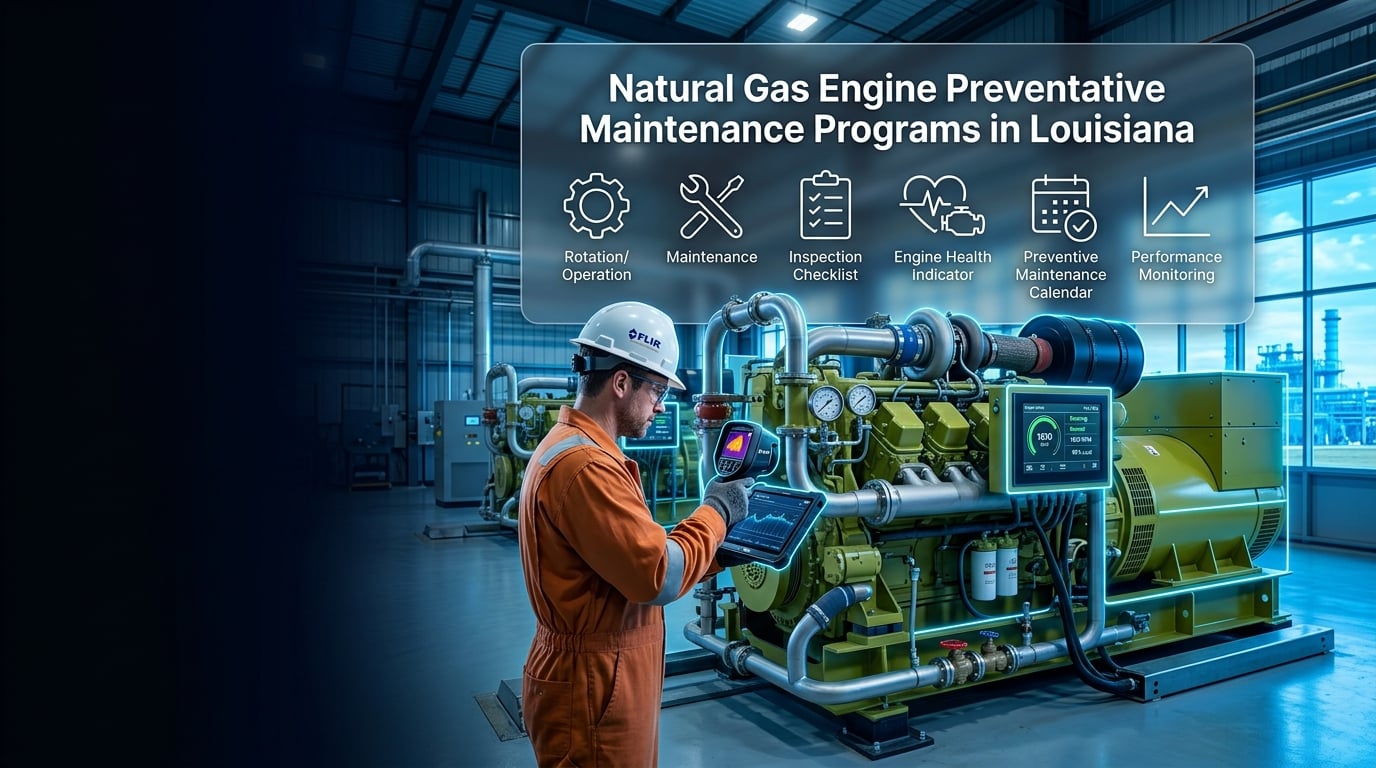
Mechanical services and preventative maintenance keep natural gas and diesel engines running safely and efficiently. Scheduled inspections, fluid analysis, and component servicing catch problems before they cause failure. Advanced Energy Services provides preventative maintenance programs for oil and gas, industrial, and fleet operations across Louisiana, reducing downtime and extending engine life.
Key Takeaways
- Preventative maintenance cuts unplanned engine downtime far below reactive, run-to-failure repair.
- Natural gas and diesel engines fail differently, so their PM schedules should differ too.
- PM A, B, and C service tiers group tasks by run hours, not calendar guesswork.
- Oil analysis and vibration testing catch wear months before a breakdown happens.
- Documented service records protect your OEM warranty and support PHMSA and LDEQ compliance audits.
A failed engine in the middle of a shift never happens at a convenient time. Whether it is a compressor at a gas station or a standby generator at a plant, unplanned downtime hits production, revenue, and safety all at once.
We have spent over 15 years maintaining natural gas and diesel engines across Louisiana’s oil and gas, municipal, and industrial markets. That field experience shapes how we build a preventative maintenance program for you, not a generic checklist copied from a manual.
In this guide, you will learn what mechanical services and preventative maintenance actually cover. You will also see how natural gas and diesel engines differ, how PM schedules break down, and what to expect from a professional service partner.
What Are Mechanical Services and Preventative Maintenance?
Mechanical services and preventative maintenance are two connected practices that keep industrial engines running. Mechanical services cover the actual repair, adjustment, and replacement work. Preventative maintenance is the scheduled plan that prevents failures before they start.
Plant managers often use these terms together. However, they solve different problems. Mechanical services fix what is broken. Preventative maintenance stops things from breaking in the first place.
Mechanical Services vs. Preventative Maintenance: What Is the Difference?
- Mechanical services: hands-on repair work on engines, compressors, and related equipment.
- Preventative maintenance: a scheduled program of inspections, fluid changes, and part replacements.
A mechanic performs mechanical services when a coupling fails. A preventative maintenance program schedules coupling inspections so that failure never happens. Both matter, but one costs far less than the other.
Why Does Professional Engine Maintenance Matter?
Untrained maintenance staff often miss early warning signs. A worn bearing sounds fine until it does not. Professional technicians catch these signs early using proper tools and training.
According to the U.S. Department of Energy, unplanned downtime costs industrial facilities thousands of dollars per hour. For a compressor station running around the clock, that adds up fast.
We have seen operators try to stretch service intervals to save money. In most cases, this backfires. A modest oil analysis fee catches problems that would otherwise cost tens of thousands in engine repairs.
Natural Gas vs. Diesel Engines: What Are the Key Maintenance Differences?
Natural gas and diesel engines share a lot of parts. However, they fail in different ways. Understanding these differences shapes how we build your PM schedule.
Fuel, Ignition & Lubrication Differences
Diesel engines rely on compression ignition. Natural gas engines use spark ignition, similar to a gasoline engine but built for continuous industrial duty. This changes spark plug wear, ignition timing, and fuel system service.
Natural gas engines also run leaner. This means combustion temperatures climb higher. As a result, lubricants must resist oxidation, so oil selection matters more than most operators realize.
What Are the Common Failure Points by Engine Type?
Diesel engines commonly show trouble in fuel injectors, turbochargers, and DPF systems. Natural gas engines more often struggle with spark plug fouling, pre-ignition, and valve recession. The table below breaks this down further.
| Factor | Natural Gas Engines | Diesel Engines |
|---|---|---|
| Ignition | Spark ignition, timed like a large industrial spark engine | Compression ignition, no spark plugs |
| Fuel system focus | Spark plugs, ignition timing, fuel mixers | Injectors, fuel pumps, DPF systems |
| Lubrication demand | Higher combustion temperatures, oxidation-resistant oil needed | Standard diesel-rated oil, shorter drain intervals under heavy load |
| Common failure points | Spark plug fouling, pre-ignition, valve recession | Injector wear, turbocharger failure, DPF clogging |
Our team can walk you through a full natural gas versus diesel comparison specific to your fleet or facility during a maintenance consultation.
Why Is Preventative Maintenance Essential?
Reduced Downtime and Extended Engine Life
Preventative maintenance catches wear before it turns into failure. This keeps compressors and generators running when you need them most. Every hour of unplanned downtime affects production, revenue, and safety.
Lower Costs and Better Fuel Efficiency
Dirty air filters and worn injectors both waste fuel. Regular servicing keeps combustion efficient, which lowers your fuel bill over time.
Small parts, like fuel filters, cost far less than the injectors they protect. Replacing them on schedule protects your bigger investment.
Safety and Regulatory Compliance
Engine failures near hazardous locations create real safety risks. NEC Article 500 governs equipment used in these classified areas, and proper maintenance keeps that equipment compliant.
OSHA 1910.119 also applies to facilities handling highly hazardous chemicals. Documented maintenance supports your compliance during an OSHA or LDEQ inspection.
Preventative vs. Predictive Maintenance: Which One Do You Need?
Key Differences
- Preventative maintenance: service performed on a fixed schedule, based on time or run hours.
- Predictive maintenance: service triggered by real-time data, like vibration or oil condition.
Preventative maintenance assumes parts wear out on a predictable curve. Predictive maintenance watches the actual condition of the part instead.
Choosing the Right Strategy
Most industrial operations benefit from a hybrid approach. Critical components get predictive monitoring, while routine items follow a preventative schedule.
We help you decide which strategy fits each system on your site, based on run hours, criticality, and failure history.
What Does a Preventative Maintenance Schedule Look Like?
Daily Checks
Daily checks take a few minutes but prevent major failures. A typical daily check includes:
- Fluid levels: oil, coolant, and fuel
- Visual leak inspection around seals and hoses
- Unusual noise or vibration during startup
- Gauge readings compared to normal operating range
- Belt and hose condition and tension
PM A, B, and C Service Tiers
We organize scheduled service into three tiers, based on run hours or mileage.
- PM A: basic service, covering fluid checks, filter changes, and visual inspection.
- PM B: mid-level service, adding deeper component checks and adjustments.
- PM C: major service, including comprehensive inspection of critical engine systems.
Each tier builds on the one before it. Skipping a tier creates gaps that show up later as expensive repairs. Ask us about our full PM A, B, and C schedule with detailed task checklists.
What Core Engine Systems Do We Service?
Fuel and Lubrication Systems
Fuel injectors, filters, and pumps all need regular attention. Contaminated fuel causes more engine damage than almost any other single factor.
Lubrication systems protect every moving part inside the engine. We test oil condition regularly to catch metal particles before they cause bearing failure.
Cooling, Air Intake, and Turbocharger Systems
Overheating remains one of the most common causes of major engine damage. We service radiators, heat exchangers, and coolant systems to prevent it.
Turbochargers spin at extremely high speeds. A worn turbo bearing can destroy an engine within minutes if it fails completely.
Ignition, Exhaust, and Emissions Systems
Natural gas engines depend on properly gapped spark plugs and correct ignition timing. Worn plugs cause misfires, power loss, and higher emissions.
Emissions compliance also matters here. We service exhaust systems to help you stay within your LDEQ air permit limits.
Electrical, Starting, and Charging Systems
Starting systems fail quietly until the moment you need them. We test batteries, starters, and charging systems on every scheduled visit.
In classified hazardous locations, electrical work must follow NEC Article 500 and NFPA 70E safety rules. Our technicians train specifically for this environment.
How Do We Diagnose and Troubleshoot Engine Problems?
Diagnostic Methods We Use
We use several diagnostic tools to catch problems early:
- Oil analysis: lab testing that reveals metal wear particles and fluid breakdown.
- Vibration analysis: sensors that detect bearing wear and misalignment.
- Fault code review: pulling stored codes from the engine control module.
- Thermal imaging: cameras that reveal hot spots before they cause failure.
What Common Problems Do We Catch Early?
Hard starting often points to fuel delivery or ignition problems. Overheating usually traces back to a cooling system issue.
Power loss can mean anything from clogged filters to turbo wear. Visible smoke almost always signals a combustion problem worth investigating right away. Ask yourself: when was the last time your engine’s fault codes were actually reviewed?
Our full diagnostics and troubleshooting process walks through each of these symptoms step by step during every service visit.
What Factors Affect Maintenance Frequency?
Operating Conditions and Environment
Gulf Coast humidity, salt air, and heat all accelerate wear. Coastal and offshore-adjacent sites often need shorter service intervals than inland facilities.
Dust and dirt at construction or agricultural sites also shorten filter life. We adjust your schedule based on your actual site conditions, not a generic chart.
Fuel Quality and Lubricant Selection
Poor fuel quality damages injectors and shortens engine life. We recommend fuel testing at sites with inconsistent supply.
The right lubricant matters just as much. Using the wrong oil viscosity can quietly wear out an engine over several years.
How Does Preventative Maintenance Differ by Equipment Type?
We service commercial trucks, standby generators, construction equipment, oil and gas compressors, agricultural engines, and marine engines. Each equipment type carries its own duty cycle and failure pattern.
A generator that runs occasionally needs different care than a compressor running continuously. Talk with our team about a maintenance plan built for your exact application.
When Does an Engine Need a Major Overhaul?
Signs an Engine Needs an Overhaul
Rising oil consumption, persistent smoke, and falling compression all point toward an overhaul. Metal particles in an oil analysis report are another strong warning sign.
Ignoring these signs rarely saves money. An engine that fails in the field costs far more than a planned overhaul.
Overhaul Planning and Spare Parts
We plan overhauls around your production schedule, not the other way around. Parts get ordered in advance to avoid extended downtime.
Spare parts availability varies by engine model. We track lead times for major components so a rebuild does not stall halfway through.
Why Does Maintenance Documentation Matter for OEM Compliance?
Service Records and Warranty Protection
Most OEM warranties require documented maintenance. Missing records can void coverage on an expensive engine, even for an unrelated failure.
We provide detailed service records after every visit. These records protect your warranty and support resale value.
Regulatory Compliance
PHMSA regulations apply to pipeline-related equipment maintenance and recordkeeping. API standards also guide maintenance practices for oil and gas equipment specifically.
Consult your compliance officer to confirm which specific PHMSA and API requirements apply to your site, since these vary by operation type.
How Is Technology Transforming Engine Maintenance?
Telematics, CMMS, and Predictive Analytics
Telematics systems now track run hours, fault codes, and location in real time. This data feeds directly into maintenance planning.
A CMMS, or computerized maintenance management system, organizes your service history in one place. Combined with predictive analytics, these tools help you move from guesswork to data-driven decisions.
Why Choose Advanced Energy Services for Mechanical Services?
Industry Experience and OEM-Certified Technicians
Advanced Energy Services brings over 15 years of field experience across Louisiana’s oil and gas, municipal, and industrial markets. Our technicians hold OEM certifications on the engine brands you rely on.
We have serviced engines through hurricane season, remote well site call-outs, and tight-deadline outages. That field experience shapes how we build your PM program.
Custom PM Programs and Emergency Field Service
Every site is different. We build custom PM programs around your equipment, run hours, and budget instead of applying a generic template.
We also provide emergency field service when something breaks outside a scheduled visit. Learn more about our mechanical services and how we support Louisiana’s industrial and oil and gas operators.
Frequently Asked Questions
How often should natural gas and diesel engines get preventative maintenance?
Service frequency depends on run hours, operating conditions, and engine type. Most industrial engines need daily checks, plus PM A service every few hundred hours. Advanced Energy Services builds a custom schedule based on your specific equipment and site conditions rather than a generic calendar.
What is the difference between preventative and predictive maintenance?
Preventative maintenance follows a fixed schedule based on time or run hours. Predictive maintenance uses real-time data, like oil analysis or vibration readings, to trigger service only when needed. Most operations benefit from combining both strategies across different engine systems.
How much does skipping preventative maintenance actually cost?
Skipping PM often trades a small scheduled cost for a much larger repair bill later. A worn bearing caught early might cost a few hundred dollars to address. Left unchecked, it can cause a complete engine failure costing tens of thousands of dollars.
What is included in a PM A, B, or C service?
PM A covers basic fluid checks, filter changes, and visual inspection. PM B adds deeper component checks and adjustments. PM C is a major service involving comprehensive inspection of critical engine systems. Each tier builds on the previous one.
Do natural gas engines need different maintenance than diesel engines?
Yes. Natural gas engines use spark ignition and need regular spark plug and ignition system service. Diesel engines rely on compression ignition and often need more attention on fuel injectors and turbochargers. Maintenance schedules should reflect these differences.
How do I know if my engine needs a major overhaul?
Watch for rising oil consumption, persistent smoke, and falling compression readings. Metal particles showing up in an oil analysis report are another strong warning sign. Advanced Energy Services can evaluate your engine and plan an overhaul around your production schedule.
Conclusion
Mechanical services and preventative maintenance protect your engines from costly, unplanned failure. Natural gas and diesel engines each carry their own risks and service needs. A structured PM program catches problems early, before they turn into expensive repairs. This approach protects your budget, your uptime, and your safety record.
From daily checks to full PM A, B, and C service tiers, every step matters. Documentation supports your OEM warranty and regulatory compliance under standards like API and PHMSA. Diagnostic tools like oil analysis and vibration testing give you a clear picture of engine health. Together, these practices keep your operation running through Louisiana’s demanding conditions.
Advanced Energy Services has spent over 15 years maintaining natural gas and diesel engines across Louisiana’s industrial and oil and gas markets. We build custom PM programs around your equipment, run hours, and budget. We also provide emergency field service when you need it most. Contact us today to schedule a consultation and build a maintenance program that fits your site.